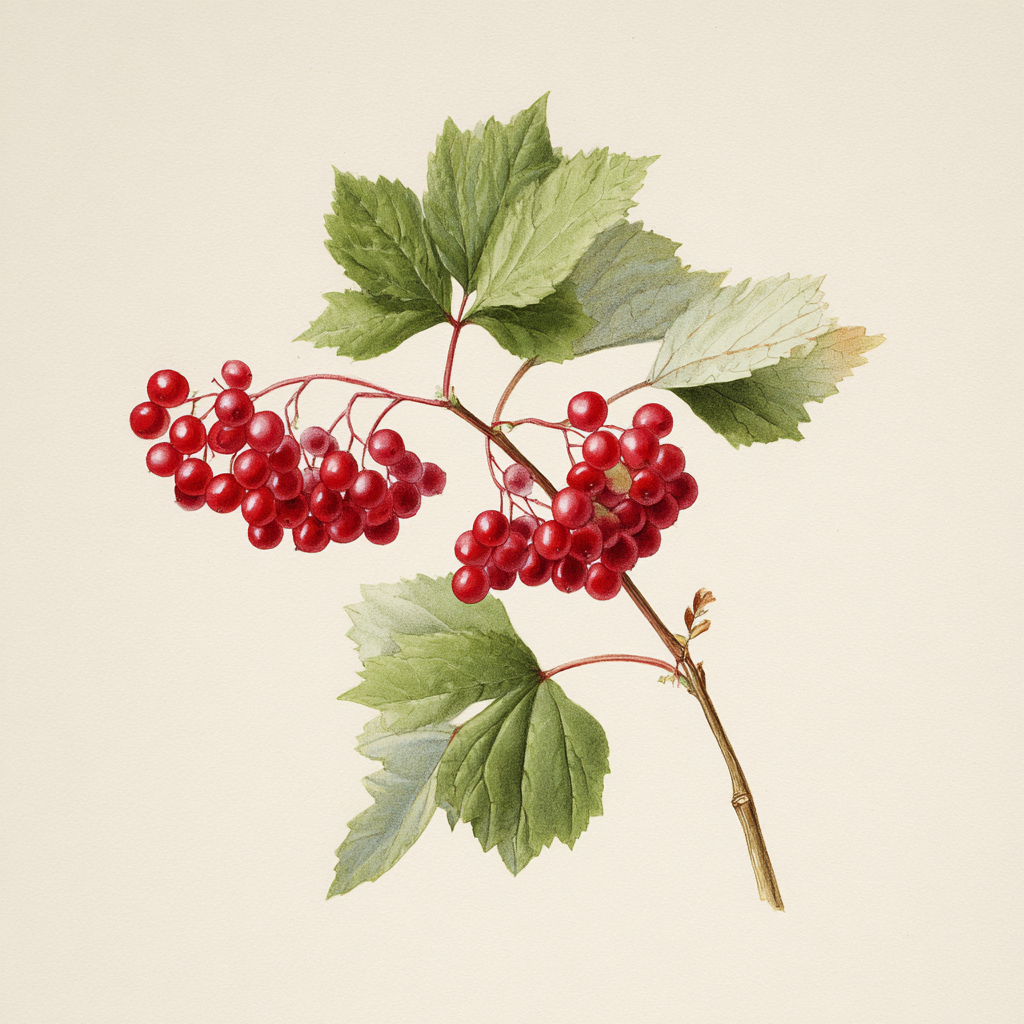
American Cranberrybush
FruitViburnum trilobum
Have seeds for this? Add to inventory →American cranberrybush is a large, ornamentally superb native viburnum with showy clusters of white flowers in spring, brilliant red to orange autumn foliage, and hanging clusters of translucent scarlet berries that persist through winter and are beloved by birds. The tart berries are edible after a hard frost softens them and make excellent jelly and sauce with a flavour closely resembling true cranberry. One of the most outstanding four-season ornamental shrubs native to North America.
Growing Conditions
Growing Conditions
Sunlight
Full Sun to Partial Shade
Water Needs
Moderate
Soil
Moist, fertile, well-drained to slightly wet loam; pH 5.5 - 7.0; tolerates clay; intolerant of prolonged dry conditions
Spacing
6 - 10 feet; upright-arching habit eventually 8 - 12 feet tall and wide
Days to Maturity
Perennial shrub; flowers and berries begin in year 2 - 3; full display from established shrub
Growing Zones
Growing Zones
Thrives in USDA Zones 2 - 7
When to Plant
When to Plant
Transplant
Plant container-grown or bare-root shrubs in spring or autumn in prepared moist soil; plant two for cross-pollination and best berry production
Harvest
Harvest berries in autumn after the first hard frost has softened them; use fresh for jelly and sauce or leave clusters for winter wildlife
Phenology (Natural Timing Cues)
Transplant
Plant American cranberrybush in spring after frost or in early autumn in moist, fertile soil. Two or more plants are recommended for cross-pollination and better berry production. Autumn planting gives good root establishment before winter.
- Soil is consistently workable and moist.
- Hard frost danger has passed (spring planting).
- Nighttime temperatures are dropping steadily below 55F (autumn planting).
- Site receives at least 4 - 6 hours of sun for best berry production.
Start Dates (Your Location)
Average dates use your saved zone; readiness also checks your forecast when available.
Best Planting Window
Spring window
Spring
Plant early enough for roots to settle before summer heat.
Autumn window
Early autumn
Plant early enough for roots to grow before winter; avoid late planting into cold, wet soil.
Planting Method
Plant nursery-grown american cranberrybush stock or rooted cuttings. Seed-grown plants are slow, variable, and usually not the best way to establish a productive planting.
Critical Timing Note
Plant while dormant and before bud break so roots establish before leaves demand water.
Use the average timing, but check your local forecast before planting.
Typical Harvest Window
September to December
Organic Growing Tips
Organic Growing Tips
Plant two or more shrubs for cross-pollination; berry production is significantly better with cross-pollinated flowers.
Monitor closely for viburnum leaf beetle, an invasive pest from Europe that can defoliate viburnums; eggs overwinter in pits in young stems - prune and destroy infested stem tips in late autumn.
Mulch generously around the base to maintain moisture; American cranberrybush does not tolerate prolonged dry conditions.
Prune immediately after flowering to shape; hard pruning of old wood every 3 - 4 years rejuvenates older shrubs.
Leave some berry clusters through winter for cedar waxwings, American robins, and other fruit-eating birds.
Care Guidance
Optional seasonal guidance for what you can do, even when nothing is urgent.
Care Guidance
Watering
If the top 2 inches of soil feel dry, a deep watering at the base may help more than frequent light watering. In healthy soil, rain may cover much of what it needs.
Feeding
Extra feeding is rarely required if soil is healthy. If growth looks pale or slow, a light compost top-dressing is often enough before adding anything stronger.
Pruning
If pruning is needed, dormancy or the period just after harvest is often the simplest window. Dead, damaged, or crossing growth is usually the first place to start.
Seasonal care
In late fall, a light cleanup and fresh mulch can help if winter protection is useful in your climate. Leaving a little space around crowns and trunks often helps air move and keeps excess moisture from sitting there.
Known Varieties
Common cultivars worth knowing
Known Varieties
Wentworth
The most reliable cultivar for fruit production; large berries in heavy clusters; confirmed American species (not the European V. opulus).
Best for
Jelly and juice making, wildlife planting, four-season ornamental
Hahs
Vigorous selection with excellent berry production and reliable autumn colour; full-size shrub suitable for screening.
Best for
Privacy screen, wildlife habitat, edible landscape
Straight Species
Seed-grown American cranberrybush with natural genetic diversity; best for wildlife planting and ecological restoration.
Best for
Restoration, wildlife habitat, naturalizing
Companion Planting
Companion Planting
Good companions
- Wild Ginger
- Ferns
- Native Asters
Support & insectary plants
Nearby plants that attract pollinators, beneficial insects, or improve soil health.
- Spicebush
Attracts pollinators and beneficial insects
- Elderberry
Attracts pollinators
Avoid planting near
No known conflicts
Common Pests
Common Pests
- Viburnum Leaf Beetle
- Aphids
- Powdery Mildew
- Gray Mold
All pest management in Garden uses safe, organic, non-toxic methods only. No synthetic pesticides, ever.
Simple Ways to Use
Simple Ways to Use
Start here if you're not sure how to use this crop in the kitchen.
Quick recipes you can make right away
Cranberrybush Sauce
Simmer the ripe fruit with a little water and sugar for 10 to 15 minutes until the berries burst and the mixture turns spoonable. Taste near the end, because the berries are tart and usually need sweetening for sauce.
Cranberrybush Jelly Juice
Cook the fruit with a little water until it softens and releases plenty of juice, then strain it well for jelly making. Use the juice while fresh, because the berries are usually better cooked than eaten plain.
Cranberrybush Syrup
Simmer the fruit, strain the juice, and cook it briefly with sugar until the liquid thickens just enough to lightly coat a spoon. Cool it before bottling, and use it for drinks or spooned over baked goods.
How to Preserve
How to Preserve
Use this section to store or process extra harvest before it spoils.
Practical methods for extra harvest
Freeze cranberrybush berries
Spread clean dry fruit in a single layer and freeze it until hard before bagging so the berries stay loose. Use them frozen for sauce, syrup, or jelly, because thawed berries soften a lot.
Make cranberrybush jelly or sauce
Cook the fruit into juice or sauce, then refrigerate or freeze small batches unless you are following a tested canning recipe for shelf-stable jars. Water-bath can it only with a tested recipe and the full processing time.
Freeze cranberrybush puree or juice
Cook and strain the fruit into juice or puree, cool it completely, and freeze it in small containers with a little headspace. Freeze in small portions so you can thaw only what you need.
New to preserving food?
New to canning? Read the safe canning guide.New to freezing? Read the freezing guide.How to Store
How to Store
Simple storage tips
Keep fresh cranberrybush fruit cold in the refrigerator and use it within about 3 to 5 days.
Store the berries dry in a shallow container so the fruit on the bottom does not crush.
Use softened or split berries first for cooking, because they are rarely best for fresh eating.
Freeze or cook the harvest quickly if you will not use it within a couple of days.
Store finished sauce or syrup in the refrigerator unless it was processed with a tested shelf-stable method.
How to Save Seed
How to Save Seed
Step-by-step seed saving
- 1
American cranberrybush can be grown from seed, but selected plants are usually propagated from cuttings or nursery stock if you want similar fruit and growth habit.
- 2
If you save seed, mash fully ripe fruit, rinse away the pulp, and keep the cleaned seeds that remain.
- 3
Dry the seeds briefly until surface moisture is gone, then store them in a cool dry place if you want to experiment.
- 4
Use cuttings or nursery plants instead of seed if your main goal is to keep the same plant type.
Native Range
Native Range
- Origin
- Native across northern North America, from the Pacific Northwest through the Great Plains and Great Lakes to New England and across boreal Canada.
- Native Habitat
- Moist forest edges, stream banks, lake shores, floodplain thickets, and rich woodland margins; tolerates periodic flooding; prefers moist, fertile, well-drained to moderately wet soils.
- Current Distribution
- Widespread in native range; widely cultivated as an ornamental and edible shrub throughout temperate North America; commonly available in native plant nurseries.
Taxonomy
Taxonomy
- Kingdom
- Plantae
- Family
- Muskroot family (Adoxaceae)
- Genus
- Viburnum
- Species
- trilobum
Morphology
Morphology
Root System
Spreading, fibrous root system with some suckering at the base; moderately deep in loose, moist soils; forms multi-stemmed clumps over time.
Stem
Multi-stemmed, upright to arching shrub 8 - 12 feet tall; bark is gray-brown, smooth on young stems and slightly scaly on old wood; branching creates a full, rounded crown.
Leaves
Opposite, 3-lobed, maple-like, 2 - 5 inches long and wide; dark green and glossy above; turning brilliant red, orange, and yellow in autumn - one of the best native shrubs for autumn colour.
Flowers
Flat-topped clusters (corymbs) 2 - 4 inches across of small white flowers with a ring of showy sterile flowers at the margin; produced abundantly in May - June; mildly fragrant; excellent for native pollinators.
Fruit
Round to oval drupes 0.25 - 0.4 inch across in large hanging clusters; ripening from green to translucent scarlet in September; tart and bitter raw, softening and improving markedly after frost; persistent through winter.
Natural History
Natural History
Viburnum trilobum, the American cranberrybush, is a native shrub of moist, rich woodlands and stream banks across the northern tier of North America, from British Columbia east to Newfoundland and south through the Great Lakes, New England, and the northern Appalachians. Despite its common name, it is not a true cranberry (Vaccinium macrocarpon) but rather a viburnum that produces similarly tart, red, cranberry-like berries. The berries are nutritionally and culinarily similar to cranberry and were used as a cranberry substitute by northern communities before true cranberry became widely available. The species has been cultivated in gardens since at least the early 18th century, when it was introduced to European gardens as a North American novelty. Its close relative, Viburnum opulus (European cranberrybush), is native to Europe and Asia and can appear very similar; V. trilobum is distinguished by the disk-shaped glands at the base of its leaf stalks (versus concave in V. opulus) and by its superior cold-hardiness and wildlife value in North American ecosystems. Many nurseries sell V. opulus under the name "cranberrybush" in North America; buyers seeking native wildlife value should confirm they are purchasing V. trilobum. The berries are an important late-season food source for cedar waxwings, American robins, eastern bluebirds, and ruffed grouse, persisting on the shrub into late winter when most other berries are gone.
Traditional Use
Traditional Use
American cranberrybush bark, known in traditional medicine as cramp bark, has one of the most specific and consistent records of any North American medicinal plant: its use for uterine cramps, muscle spasms, and menstrual pain. This use was independently documented among multiple Indigenous nations and was later adopted into eclectic medicine in the 19th century, where it remained in use into the early 20th century.
Parts Noted Historically
Ojibwe, Cree, and Great Lakes Indigenous peoples - Bark
Ethnobotanical records from the Ojibwe, Cree, and other Great Lakes and boreal peoples document the use of viburnum bark decoctions for uterine cramps, menstrual irregularity, and as a uterine antispasmodic. Bark tea preparations were administered as antispasmodic remedies, and the plant appears consistently across multiple independent ethnobotanical surveys of northern Indigenous medicinal practice.
19th century North American eclectic medicine - Bark
American eclectic physicians of the mid-19th century adopted viburnum bark (cramp bark) into their materia medica based on Indigenous use and clinical observation. King's American Dispensatory (1898) documented cramp bark as a reliable uterine antispasmodic used for dysmenorrhea, threatened miscarriage, and ovarian pain. Viburnum opulus bark was the more commonly cited species in eclectic medicine, but V. trilobum bark was used interchangeably in North American practice.
European phytotherapy, 20th century - Bark
Viburnum opulus bark entered European phytotherapy as "cramp bark" after being adopted from North American Indigenous and eclectic traditions. It is used in British herbal medicine and German phytotherapy for dysmenorrhea and muscle cramps, and standardized extracts are marketed across Europe. Active constituents include scopoletin (a coumarin with muscle-relaxant properties), chlorogenic acid, and viburnine.
The bark of American cranberrybush has a long history of traditional antispasmodic use, but self-treatment for gynecological conditions is not appropriate without medical guidance; the plant should not be used during pregnancy without expert supervision. The raw berries contain viburnum tannins and valerianic-acid derivatives that can cause nausea and vomiting in large quantities when eaten raw; berries are best cooked before consumption.
This information is provided for historical and educational purposes only and is not medical advice. Always consult a qualified healthcare professional before making decisions related to your health.
Loading photo submission…