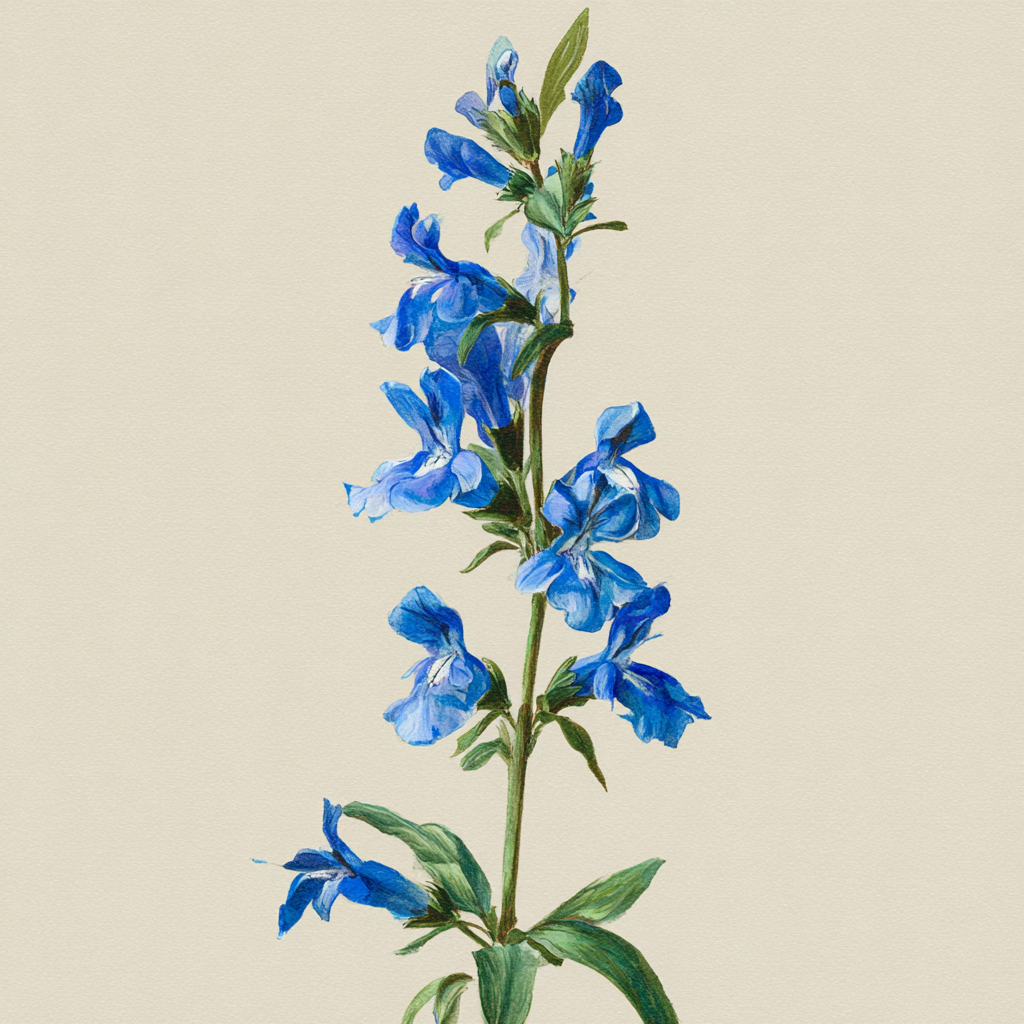
Blue Pitcher Sage
FlowerSalvia azurea
Have seeds for this? Add to inventory →Blue Pitcher Sage is a tall, airy North American native perennial renowned for its billowing spikes of sky-blue flowers that bloom in late summer and fall when few other perennials are at their peak. It thrives in hot, dry conditions and poor soils, making it an ideal low-maintenance choice for prairie-style and naturalistic garden designs. Bees, butterflies, and hummingbirds flock to its nectar-rich blooms, making it one of the most valuable late-season pollinator plants in its native range.
Growing Conditions
Growing Conditions
Sunlight
Full Sun
Water Needs
Low
Soil
Well-drained, lean to average soil; tolerates sandy, rocky, or clay loam; does not perform well in heavy wet soils
Spacing
24 to 36 inches
Days to Maturity
Blooms first season from transplant; peak bloom in late summer to fall
Growing Zones
Growing Zones
Thrives in USDA Zones 5 - 9
When to Plant
When to Plant
Start Indoors
8-10 weeks before last frost
Transplant
After last frost when soil has warmed, typically late spring
Direct Sow
Direct sow in fall or early spring into prepared ground; cold stratification improves germination
Harvest
Harvest flower spikes for cutting or deadhead to extend bloom; allow seed heads to stand for winter bird interest and self-sowing
Phenology (Natural Timing Cues)
Start Indoors
Start seeds indoors 8-10 weeks before your last expected frost to get transplant-size plants ready for late-spring establishment. Blue Pitcher Sage seed germinates slowly and unevenly; starting early ensures robust plants that will bloom in their first season. If started too late, plants may not establish well enough to bloom before frost.
- Forsythia is past bloom and lilac buds are swelling
- Daytime temperatures are consistently above 50°F outdoors
- Last frost date is still 8-10 weeks away
Transplant
Transplant outdoors after all frost danger has passed and soil temperatures have reached at least 55°F. Blue Pitcher Sage is tap-rooted once established and dislikes disturbance, so transplant young seedlings while roots are still small and pliable. Planting in wet or cold soil invites crown rot and stunted establishment.
- Soil is workable and draining cleanly after spring rains
- Tender annual weeds are actively germinating in open ground
- Nighttime temperatures are reliably above 45°F
- Oak leaves are approaching half their full size
Start Dates (Your Location)
Average dates use your saved zone; readiness also checks your forecast when available.
Average Last Frost
Set your growing zone to see personalized calendar dates.
Use the average timing, but check your local forecast before planting.
Direct Sow
Early spring
Use the seasonal timing note for this plant.
Typical Harvest Window
August to October
Organic Growing Tips
Organic Growing Tips
Amend planting holes with a small amount of finished compost only; overly rich soil causes floppy, weak stems that require staking
Top-dress with a thin layer of worm castings in early spring to support early-season root activity without triggering excessive leafy growth
Mulch lightly around the base with shredded leaves or straw to retain soil moisture through summer drought, keeping mulch away from the crown to prevent rot
Cut plants back by one-third in early summer (Chelsea chop) to promote bushier growth and reduce the need for staking on clay or rich soils
Allow seed heads to remain through winter to feed goldfinches and sparrows while providing natural self-sowing for colony expansion
Divide clumps every 3-4 years in early spring when basal growth is just emerging to maintain vigor and share divisions
Care Guidance
Optional seasonal guidance for what you can do, even when nothing is urgent.
Care Guidance
Watering
Extra watering is often only useful during extended dry periods. If the top 2 to 3 inches are still holding moisture, additional water may not help.
Feeding
If growth is strong, compost-rich soil often carries most of the load. If the plant starts looking pale or stalls, a light compost top-dressing or gentle organic feed may help.
Seasonal care
In late fall, a light cleanup and fresh mulch can help if winter protection is useful in your climate. Leaving a little space around crowns and trunks often helps air move and keeps excess moisture from sitting there.
Harvest timing
Harvests often cluster around August to October. If fruit, leaves, or roots start looking ready, color, size, firmness, and scent usually tell you more than the calendar alone.
Known Varieties
Common cultivars worth knowing
Known Varieties
Salvia azurea var. grandiflora
The most commonly cultivated variety, with larger individual flowers and a more robust habit than the straight species; this is the form sold in most native plant nurseries.
Best for
Garden borders, prairie plantings, and pollinator gardens
'Nekan'
A selected cultivar from the Great Plains with notably compact, upright growth to about 3.5 feet, reducing the flopping typical of the species in garden conditions.
Best for
Smaller gardens or mixed borders where height control matters
Salvia azurea (straight species)
The wild-type species with slightly smaller flowers and a looser, more open habit; most genetically diverse and best for ecological restoration plantings.
Best for
Naturalistic meadow restorations and seed-source conservation
Companion Planting
Companion Planting
Good companions
Support & insectary plants
Nearby plants that attract pollinators, beneficial insects, or improve soil health.
- Echinacea
Attracts pollinators and beneficial insects
- Black-eyed Susan
Attracts pollinators and beneficial insects
- Little Bluestem
Deep-rooted nutrient recycler; useful for chop-and-drop mulch
- Goldenrod
Attracts beneficial insects and produces nutrient-rich mulch
- Ironweed
Attracts pollinators
Common Pests
Common Pests
All pest management in Garden uses safe, organic, non-toxic methods only. No synthetic pesticides, ever.
Native Range
Native Range
- Origin
- Native to the central United States, primarily the Great Plains and Southeast.
- Native Habitat
- Dry prairies, open woodlands, limestone glades, and rocky hillsides.
- Current Distribution
- Central and southeastern United States; increasingly popular in native plant gardens for late-season blooms attractive to bumblebees.
Taxonomy
Taxonomy
- Kingdom
- Plantae
- Family
- Mint family (Lamiaceae)
- Genus
- Salvia
- Species
- azurea
Morphology
Morphology
Root System
Develops a deep, fibrous-anchored tap root that makes established plants highly drought tolerant but sensitive to transplanting; avoid dividing or disturbing roots after the first growing season unless absolutely necessary.
Stem
Stems are slender, upright, and woody at the base, reaching 3-5 feet tall; plants can become floppy in rich soils or shaded conditions, so lean soil and full sun are critical for self-supporting growth.
Leaves
Narrow, linear to lance-shaped gray-green leaves are softly hairy and aromatic when crushed; yellowing or sparse lower foliage mid-season is normal as the plant pushes energy into flowering, not a sign of disease.
Flowers
Tubular, two-lipped sky-blue to azure flowers are borne in loose whorled spikes from late July through October; the long bloom window and abundant nectar make this one of the most important fall-foraging resources for native bees and migrating monarchs.
Fruit
After bloom, small four-parted nutlets form within the persistent calyces; seed heads are modest and unshowy but viable, and plants self-sow freely in open, disturbed soil.
Natural History
Natural History
Salvia azurea is native to the tallgrass and mixed prairies of central and eastern North America, ranging from Nebraska and Kansas east through the Carolinas and south into Texas and Florida. It grows naturally in dry open prairies, rocky barrens, and open woodland edges where competition from taller vegetation is limited. The species name azurea, Latin for sky-blue, was formalized by French botanist Antoine Laurent de Jussieu in the early nineteenth century. Unlike many salvias, it develops a deep tap root that anchors it against drought and prairie fire, and its late-season bloom window makes it an ecologically critical nectar source as most other prairie wildflowers are fading.
Traditional Use
Traditional Use
Several Indigenous peoples of the Great Plains and Southeast documented use of Salvia azurea leaves and roots in traditional practices. Historical ethnobotanical records indicate its use was regional and specific rather than broadly widespread, and documentation is sparser than for related species such as Salvia officinalis.
Parts Noted Historically
Comanche, southern Great Plains, 19th century - leaves
Ethnobotanical records collected in the 19th century document Comanche use of the leaves in preparations associated with respiratory complaints, as noted in early US Bureau of Ethnology field reports.
Cherokee, southeastern North America - roots
Cherokee botanical knowledge catalogued by ethnobotanist James Mooney and later researchers noted root preparations associated with cold-related ailments, recorded as part of broader documentation of southeastern native plant traditions.
Blue Pitcher Sage contains volatile oils and diterpenes common to the Salvia genus; large quantities of the leaves may cause mild irritation. No significant toxicity is documented at ornamental garden exposure levels, but the plant is not a culinary sage and is not used as a food plant.
This information is provided for historical and educational purposes only and is not medical advice. Always consult a qualified healthcare professional before making decisions related to your health.
Loading photo submission…