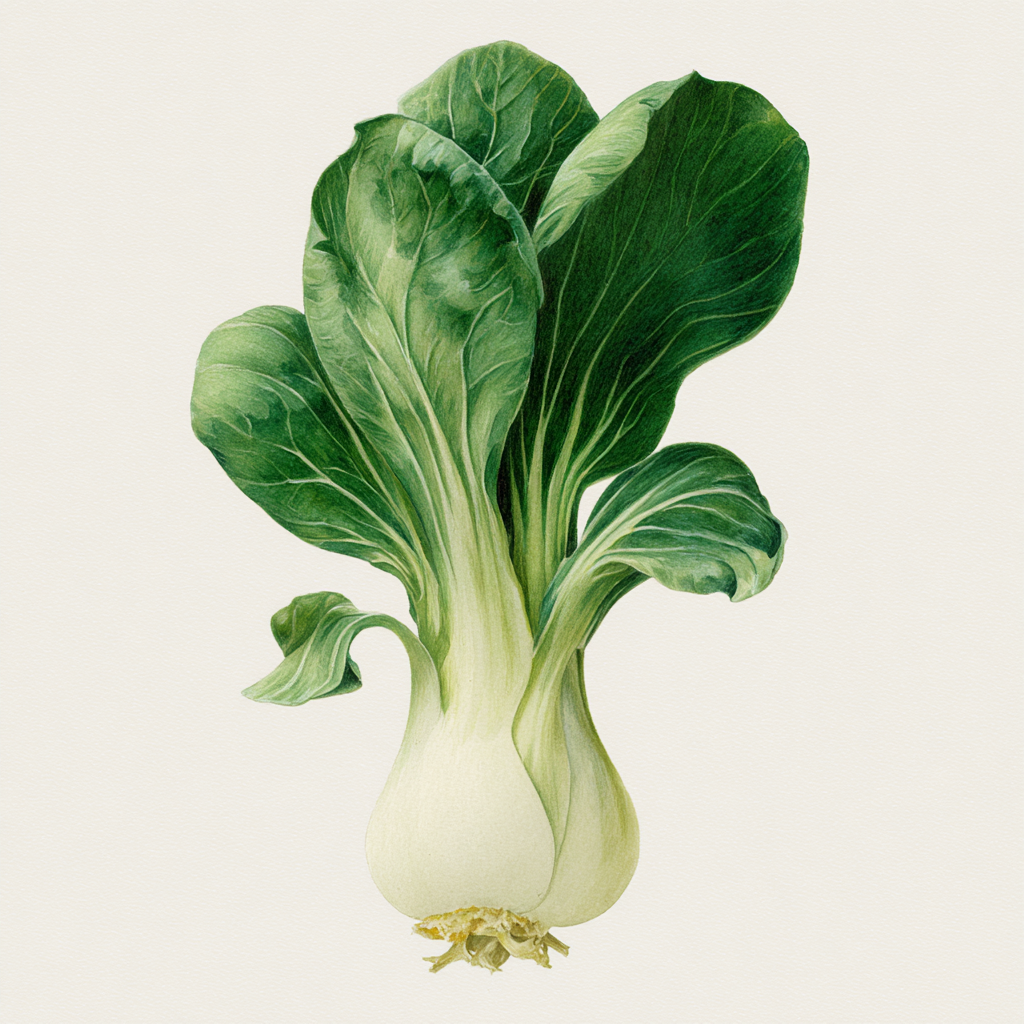
Bok Choy
VegetableBrassica rapa subsp. chinensis
Have seeds for this? Add to inventory →Bok choy is a fast-maturing cool-season brassica prized for its crisp, mild white stems and tender dark-green leaves. It thrives in spring and fall gardens, tolerating light frost but bolting quickly in summer heat. Its compact size and short days to maturity make it one of the most productive vegetables for small spaces and successive sowings.
Growing Conditions
Growing Conditions
Sunlight
Full Sun to Partial Shade
Water Needs
Moderate
Soil
Rich, well-draining loam with consistent moisture and high organic matter; pH 6.0–7.0
Spacing
6–12 inches
Days to Maturity
45–60 days from transplant
Growing Zones
Growing Zones
Thrives in USDA Zones 2 - 10
When to Plant
When to Plant
Start Indoors
4–6 weeks before last frost for spring crop; 6 weeks before first fall frost for fall crop
Transplant
2–4 weeks before last frost date in spring; 4 weeks before first fall frost
Direct Sow
2–4 weeks before last frost in spring; 6–8 weeks before first fall frost for fall crop
Harvest
Cut entire head at soil level when stems are firm and full but before flower stalks form; or harvest outer leaves individually for ongoing production
Phenology (Natural Timing Cues)
Start Indoors
Start bok choy indoors to get a jump on the cool season; seedlings tolerate mild chill but must be transplanted before soil warms past 75°F or bolting risk rises sharply. Indoor starts are especially useful for fall crops, giving transplants a controlled start during the hottest weeks. Seedlings are ready in 3–4 weeks and should not be left in trays too long, as root-bound transplants stress easily and bolt sooner.
- Forsythia is blooming or just finishing for spring indoor starts
- Daytime temperatures are still regularly dipping below 50°F outdoors
- Soil is workable but not yet consistently warm for direct sow
- For fall crop: summer heat is near its peak and outdoor soil is too hot for direct germination
Direct Sow
Direct sowing works well when soil is cool and moist; bok choy germinates quickly and thinning doubles as an early harvest of baby greens. Sowing too late into warming spring soils risks immediate bolting; sowing fall crops too early while soil remains hot above 80°F causes poor germination. Aim for soil temperatures between 50°F and 75°F for reliable stands.
- Soil thermometer reads 50–75°F at 2-inch depth
- Dandelions are blooming or tender annual weeds are germinating in open ground
- Nights are consistently cool, below 55°F, but hard frost risk is past
- For fall crop: summer heat is visibly easing and evenings are dropping into the 60s
Start Dates (Your Location)
Average dates use your saved zone; readiness also checks your forecast when available.
Average Last Frost
Set your growing zone to see personalized calendar dates.
Use the average timing, but check your local forecast before planting.
Typical Harvest Window
March, April, May, September, October, November
Organic Growing Tips
Organic Growing Tips
Side-dress with worm castings or compost at transplanting and again at 3 weeks to sustain the rapid leaf growth bok choy needs for quality heads
Apply a 2-inch layer of straw or shredded leaf mulch to retain soil moisture and moderate soil temperature swings that trigger bolting
Use row cover to protect from flea beetles and cabbage loopers without pesticides; remove briefly for any necessary inspection and replace promptly
Brew a dilute compost tea from finished compost and apply as a foliar spray every 2 weeks to boost leaf vigor and encourage beneficial soil microbes
Interplant with dill or nasturtium to attract aphid predators such as lacewings and hoverflies that reduce pest pressure naturally
Rotate brassicas to a new bed each season to prevent clubroot and other soil-borne diseases from building up; a 3-year rotation is ideal
Care Guidance
Optional seasonal guidance for what you can do, even when nothing is urgent.
Care Guidance
Watering
If the top 2 inches of soil feel dry, a deep watering at the base may help more than frequent light watering. In healthy soil, rain may cover much of what it needs.
Feeding
If growth is strong, compost-rich soil often carries most of the load. If the plant starts looking pale or stalls, a light compost top-dressing or gentle organic feed may help.
Seasonal care
During the main season, harvesting when the crop is ready and removing damaged growth can help keep the planting productive if it starts to look crowded or tired.
Harvest timing
Harvests often cluster around March, April, May, September, October, November. If fruit, leaves, or roots start looking ready, color, size, firmness, and scent usually tell you more than the calendar alone.
Known Varieties
Common cultivars worth knowing
Known Varieties
Shanghai Green
Compact baby-type bok choy with light green stems and spoon-shaped leaves; matures in 30–40 days and is notably slow to bolt compared to standard types.
Best for
Small gardens, containers, and succession planting
Prize Choy
A full-size open-pollinated variety with broad white stems and dark green leaves; reliable performance across a wide range of cool-season conditions with good bolt resistance.
Best for
Main-season spring and fall crops
Joi Choi
Vigorous hybrid with thick white petioles and excellent uniformity; slightly more heat-tolerant than most varieties, extending the harvest window at season edges.
Best for
Growers in regions with unpredictable spring warming
Mei Qing Choy
Dwarf variety with jade-green stems and dense rosette habit; extremely fast at 30–35 days and particularly suited to cut-and-come-again harvesting of baby greens.
Best for
Cut-and-come-again harvest and container growing
Companion Planting
Companion Planting
Support & insectary plants
Nearby plants that attract pollinators, beneficial insects, or improve soil health.
- Nasturtium
Trap crop for aphids; attracts beneficial insects
Avoid planting near
- Strawberries
- Tomatoes
- Peppers
Common Pests
Common Pests
- Flea Beetles
- Cabbage Loopers
- Aphids
- Slugs
- Cabbage Root Maggot
- Whitefly
All pest management in Garden uses safe, organic, non-toxic methods only. No synthetic pesticides, ever.
Simple Ways to Use
Simple Ways to Use
Start here if you're not sure how to use this crop in the kitchen.
Quick recipes you can make right away
Quick Sauteed Bok Choy
Slice the stalks and leaves separately, cook the stalks in a little oil for 2 to 3 minutes, then add the leaves for 1 to 2 minutes more until just wilted. Stop while the stalks still have a little crunch instead of cooking them down too far.
Steamed Bok Choy
Halve baby bok choy or chop larger heads, then steam 3 to 5 minutes until the stalks are tender and the leaves are fully wilted. Drain any extra water before serving so the dish does not turn watery.
Bok Choy Soup Stir-In
Add chopped bok choy to simmering broth for the last 2 to 4 minutes until the stalks soften and the leaves turn deep green. Add it near the end so it stays fresh-tasting instead of mushy.
How to Preserve
How to Preserve
Use this section to store or process extra harvest before it spoils.
Practical methods for extra harvest
Freeze blanched bok choy
Wash and chop the stalks and leaves, blanch them 1 to 2 minutes, then chill them fully in cold water so they stop cooking. Drain well, pack into small portions, and freeze for soups or stir-fries.
Freeze cooked bok choy
Saute or steam bok choy until just tender, cool it completely, and pack it into freezer containers or bags. Use it later in noodles, soup, or rice dishes, because thawed bok choy is too soft for fresh use.
Dry bok choy leaves for soup flakes
Spread clean leaves in a thin layer and dry them at low heat until they crumble easily and no thick rib feels cool or flexible, usually several days depending on humidity. Cool them fully before storing so the jar stays dry.
New to preserving food?
New to freezing? Read the freezing guide.New to dehydrating? Read the dehydrating guide.How to Store
How to Store
Simple storage tips
Keep bok choy cold in the refrigerator and use it within about 3 to 5 days for the best texture.
Store it dry in a bag or covered container lined with a towel so extra moisture does not sit around the stems.
Wash only before cooking unless it is very dirty, because trapped water shortens storage life.
Use yellowing, bruised, or split heads first, because bok choy declines quickly once damaged.
Discard heads that smell sour or feel slimy at the base.
How to Save Seed
How to Save Seed
Step-by-step seed saving
- 1
If the packet or tag says F1 hybrid, saved seed may not stay true. Open-pollinated bok choy is the better choice if you want similar plants next season.
- 2
Let selected plants bolt, flower, and form seed pods, then wait until most pods turn tan and dry on the plant.
- 3
Cut the dry stalks before a long wet spell if possible and let them finish drying under cover until the pods snap instead of bend.
- 4
Thresh only when fully dry, and store the seed in a cool dry place in a labeled packet or jar.
Native Range
Native Range
- Origin
- Bok choy originates in southern China, where Brassica rapa was domesticated and selected over many centuries into distinct non-heading leafy forms.
- Native Habitat
- Cultivated in garden and agricultural settings across temperate to subtropical lowland regions; no wild progenitor population persists in a truly natural habitat distinct from cultivation.
- Current Distribution
- Widely cultivated across East and Southeast Asia, and grown as a cool-season garden vegetable in temperate regions worldwide, including North America, Europe, and Australia.
Taxonomy
Taxonomy
- Kingdom
- Plantae
- Family
- Mustard family (Brassicaceae)
- Genus
- Brassica
- Species
- Brassica rapa subsp. chinensis
Morphology
Morphology
Root System
Shallow fibrous roots concentrate in the top 6–8 inches of soil, making consistent surface moisture essential and deep cultivation near plants likely to cause damage.
Stem
The thick, crisp white or pale green petioles are the primary edible stalk; in bolting plants the central stem rapidly elongates and turns woody, signaling the harvest window has closed.
Leaves
Dark green, slightly glossy leaves with prominent white midribs; yellowing outer leaves indicate nitrogen deficiency or overwatering, while pale mottling or distortion often signals aphid or flea beetle feeding.
Flowers
Small yellow four-petaled flowers typical of the mustard family appear quickly once bolting begins; once the flower stalk is visible the stems lose their crispness, but flowers are edible and attract beneficial insects.
Fruit
Slender seed pods form after flowering and contain small round seeds useful for saving; allow pods to fully dry and brown on the plant before harvesting seed for the next season.
Natural History
Natural History
Bok choy is a subspecies of Brassica rapa with roots in southern China, where it has been cultivated for over 1,500 years. Chinese agricultural texts from the Tang Dynasty period reference non-heading cabbages grown for their white stalks and succulent leaves. The crop spread across East and Southeast Asia through trade and migration routes, becoming a staple in Cantonese, Japanese, and Korean cuisines. Unlike heading cabbages, bok choy was selected for rapid leaf and stem development rather than dense head formation, giving it the quick maturity that makes it exceptionally well suited to succession planting and small-plot kitchen gardening.
Traditional Use
Traditional Use
In traditional Chinese dietary culture, bok choy was documented more as a nourishing food than a formal medicinal plant, though classical Chinese texts recognized brassica vegetables for their cooling properties in the context of humoral dietary theory. Records from the Qing Dynasty period describe leafy brassicas as suitable foods for clearing internal heat. Its role in traditional practice was primarily culinary and nutritional rather than pharmaceutical.
Parts Noted Historically
Classical Chinese dietary medicine, Tang to Qing Dynasty periods - Leaves and stems
Chinese dietary texts categorized non-heading brassicas including bok choy among vegetables associated with cooling and moistening properties according to classical Five Element and yin-yang dietary frameworks, recording them as appropriate seasonal foods in warm weather
Cantonese culinary tradition, southern China - Whole plant
Cantonese culinary records from the 18th and 19th centuries document bok choy as a staple market green valued for its mildness and digestibility compared to stronger brassicas, with specific varieties noted for their tenderness at different seasonal harvests
Bok choy contains goitrogens, compounds that may interfere with thyroid function when consumed raw in very large quantities over time; cooking largely deactivates these compounds. Individuals managing thyroid conditions may wish to note this historical dietary context.
This information is provided for historical and educational purposes only and is not medical advice. Always consult a qualified healthcare professional before making decisions related to your health.
Loading photo submission…