Buckeye
FlowerAesculus glabra
Have seeds for this? Add to inventory →Ohio Buckeye is the state tree of Ohio, a native deciduous tree of the central and eastern US producing distinctive shiny, round, dark brown seeds in a spiny husk - the namesake "buckeyes" that resemble a deer's eye. The pale yellow-green flower clusters attract hummingbirds and long-tongued bees. IMPORTANT: All parts of the buckeye tree are toxic to humans, horses, and livestock - the nuts must never be eaten.
Growing Conditions
Growing Conditions
Sunlight
Full Sun to Partial Shade
Water Needs
Moderate
Soil
Deep, moist, well-draining fertile loam; prefers rich, slightly acidic soils; pH 6.0 - 7.0; does not tolerate drought or shallow soils
Spacing
20 - 40 feet
Days to Maturity
Meaningful canopy in 10-15 years; full size in 20-40 years
Growing Zones
Growing Zones
Thrives in USDA Zones 3 - 7
When to Plant
When to Plant
Transplant
Plant balled-and-burlapped or container stock in early spring before bud break, or in fall after leaf drop
Direct Sow
Sow fresh nuts in autumn 2-3 inches deep immediately after collection; nuts lose viability rapidly and must be planted fresh or cold-stored moist
Harvest
No food harvest - all parts of the tree are toxic; nuts can be collected for craft use or propagation
Phenology (Natural Timing Cues)
Transplant
Buckeye transplants best while dormant. It is one of the earliest trees to leaf out in spring - often the first native tree to show leaves - so spring planting must happen very early before bud break. Fall planting after leaf drop is an excellent option in zones 5 and warmer.
- Deciduous trees have fully dropped leaves (fall planting).
- Very early spring, before any bud movement on buckeye (spring planting); buckeye leaves out earlier than most trees.
Start Dates (Your Location)
Average dates use your saved zone; readiness also checks your forecast when available.
Best Planting Window
Spring window
Early spring
Plant as soon as the soil is workable so roots establish before heat arrives.
Autumn window
Usually skip autumn planting
Use spring unless you have locally grown nursery stock and enough mild weather for roots to establish.
Planting Method
Use nursery-grown planting stock rather than treating this as a standard seed-starting crop.
Critical Timing Note
Plant while dormant and before bud break so roots establish before leaves demand water.
Use the average timing, but check your local forecast before planting.
Organic Growing Tips
Organic Growing Tips
Mulch broadly under the drip line with wood chips to retain the consistent soil moisture buckeye requires.
Leaf blotch and early leaf drop in dry summers are common and not fatal; they reflect moisture stress more than disease. Improve soil moisture retention rather than spraying.
Plant in afternoon shade in the warmest part of zone 7 to reduce heat and drought stress.
Collect and dispose of fallen nuts if children or dogs frequent the area; the nuts are toxic if ingested.
Care Guidance
Optional seasonal guidance for what you can do, even when nothing is urgent.
Care Guidance
Watering
If the top 2 inches of soil feel dry, a deep watering at the base may help more than frequent light watering. In healthy soil, rain may cover much of what it needs.
Feeding
Extra feeding is rarely required if soil is healthy. If growth looks pale or slow, a light compost top-dressing is often enough before adding anything stronger.
Pruning
If pruning is needed, dormancy or the period just after harvest is often the simplest window. Dead, damaged, or crossing growth is usually the first place to start.
Seasonal care
In late fall, a light cleanup and fresh mulch can help if winter protection is useful in your climate. Leaving a little space around crowns and trunks often helps air move and keeps excess moisture from sitting there.
Known Varieties
Common cultivars worth knowing
Known Varieties
Yellow Buckeye (A. flava)
Appalachian species growing 60-75 feet; yellow flowers, smooth-husked fruit, and slightly more alkaline soil tolerance than Ohio Buckeye. The largest native North American buckeye.
Best for
Zones 4-8; larger landscapes; Appalachian and mid-Atlantic gardens
Red Buckeye (A. pavia)
Small native tree or large shrub (10-20 feet) with brilliant scarlet red flowers; outstanding hummingbird plant native to the southeastern coastal plain. Hardy to zone 4-5.
Best for
Small gardens; hummingbird planting; southeastern US
California Buckeye (A. californica)
Pacific native with fragrant white to pink flowers; drought-deciduous, dropping leaves in summer. Native to California foothills.
Best for
California dry gardens; drought-adapted western landscapes
Companion Planting
Companion Planting
Good companions
- Wild Ginger
- Native Ferns
- Trillium
Support & insectary plants
Nearby plants that attract pollinators, beneficial insects, or improve soil health.
- Wild Bergamot
Attracts pollinators and beneficial insects
- Serviceberry
Attracts pollinators
Avoid planting near
No known conflicts
Common Pests
Common Pests
- Leaf Blotch
- Leaf Scorch
- Powdery Mildew
- Scale Insects
- Japanese Beetle
All pest management in Garden uses safe, organic, non-toxic methods only. No synthetic pesticides, ever.
Native Range
Native Range
- Origin
- Native to the central and southern hardwood forests of the eastern United States, from Pennsylvania and southern Michigan west to Nebraska and south to Alabama and Texas.
- Native Habitat
- Rich, moist bottomland and lower-slope forests on fertile, deep soils; also found on rocky upland sites and forest edges along the Appalachian foothills.
- Current Distribution
- Native forest tree throughout the central eastern United States; the state tree of Ohio. Planted as an ornamental outside its native range.
Taxonomy
Taxonomy
- Kingdom
- Plantae
- Family
- Soapberry family (Sapindaceae)
- Genus
- Aesculus
- Species
- Aesculus glabra
Morphology
Morphology
Root System
Deep taproot with spreading lateral roots; roots prefer moist, rich soils and will surface under dry conditions.
Stem
Medium-sized deciduous tree reaching 20-40 feet with a broad, rounded crown; bark is grey-brown with irregular, somewhat corky ridges. Young twigs have a characteristic unpleasant odor when broken.
Leaves
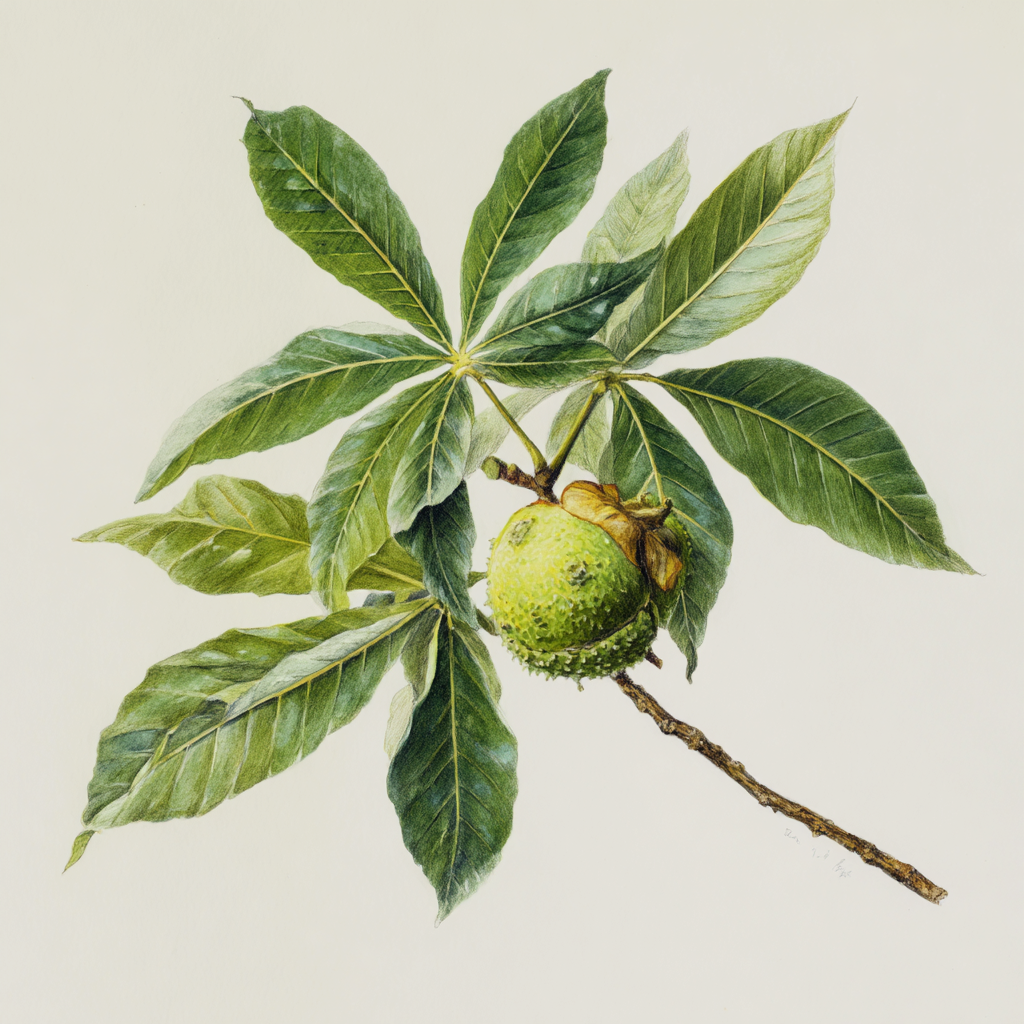
Palmately compound leaves with 5 leaflets radiating from a central point like an open hand; leaflets are 4-6 inches long, finely toothed, and turn a muted orange-yellow in autumn. One of the first deciduous trees to leaf out in spring.
Flowers
Upright, pyramidal panicles 4-7 inches tall carrying pale yellow-green flowers in May; distinctly tubular flowers with long exserted stamens attract hummingbirds and long-tongued native bees. Less showy than Horse Chestnut but ecologically more valuable to native pollinators.
Fruit
Round, spiny husks 1-2 inches diameter containing 1-3 smooth, dark brown, shiny nuts with a large pale scar; husks split at maturity to reveal the glossy nuts. Toxic if eaten.
Natural History
Natural History
Ohio Buckeye (Aesculus glabra) is native to the central and southern hardwood forests of the eastern United States, from Pennsylvania and Michigan west to Nebraska and south to Alabama and Texas, growing most abundantly in Ohio - its adopted symbol. The common name "buckeye" comes from the shiny, dark brown nuts with a pale scar that resembles the eye of a deer or buck. Ohio was called "The Buckeye State" by the time of William Henry Harrison's 1840 presidential campaign, when Harrison adopted the buckeye as a campaign symbol and log-cabin imagery. The Ohio Buckeye is one of the earliest native trees to leaf out in spring - sometimes weeks before other species - and one of the first to drop its leaves in late summer drought, giving it an unusually short leaf season. The closely related European Horse Chestnut (Aesculus hippocastanum) is a widely planted ornamental species introduced from the Balkans; it is larger, showier, and slightly less toxic than the native species but shares the same toxic saponins. The California Buckeye (Aesculus californica) is a native Pacific species with fragrant flowers particularly toxic to honeybees. The Aesculus genus has a distinctly disjunct distribution, with species in North America, Europe, and East Asia - reflecting an ancient Tertiary distribution across the Northern Hemisphere.
Traditional Use
Traditional Use
Buckeye preparations from bark and nut were documented in some Native American and early American folk medicine records, primarily for rheumatism and as a topical preparation, despite the known toxicity. These uses require careful context and should not be replicated without professional guidance.
Parts Noted Historically
Cherokee and other eastern woodland peoples - Bark and nuts
Ethnobotanical records document Cherokee and Delaware peoples using buckeye preparations in limited, specific contexts: bark decoctions applied externally for rheumatism and as a topical treatment, and processed nut preparations historically noted for narcotic properties used in fish stunning. Indigenous peoples across North America used various saponin-rich plants to stun fish in still water by throwing crushed plant material into pools - a practice that was efficient but is now illegal. The toxic saponins in buckeye nuts cause fish to rise to the surface where they can be collected.
American folk medicine carrying tradition - Nuts (carried as charm)
The tradition of carrying a buckeye nut in the pocket as protection against rheumatism and as a good-luck charm is documented in American folk medicine from the 18th century onward, particularly in Ohio and Pennsylvania. This is a sympathetic magic tradition rather than an ingested preparation - the nut is carried, not consumed. The smooth, weighty, tactile quality of the nut likely contributed to its use as a worry stone and charm object.
ALL PARTS OF BUCKEYE ARE TOXIC. The nuts, leaves, bark, and roots contain aesculin (a coumarin glycoside) and triterpenoid saponins that cause vomiting, muscle weakness, paralysis, and in severe cases death if ingested by humans, horses, dogs, or livestock. Do not eat any part of the tree. Do not use buckeye preparations internally. Despite folk traditions, the nuts should not be consumed.
This information is provided for historical and educational purposes only and is not medical advice. Always consult a qualified healthcare professional before making decisions related to your health.
Loading photo submission…