Cardinal Flower
FlowerLobelia cardinalis
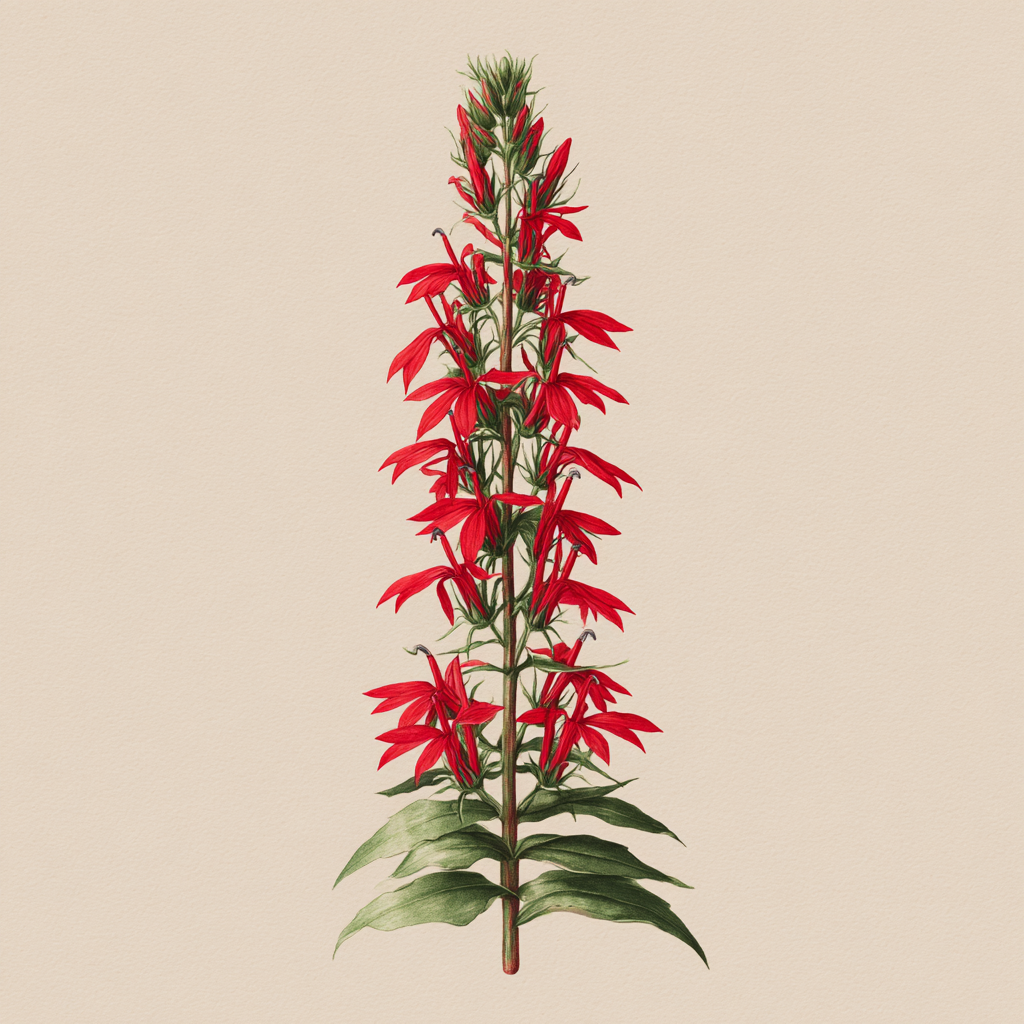
Have seeds for this? Add to inventory →Cardinal Flower is a striking native North American perennial renowned for its tall spikes of vivid scarlet-red blooms that appear in mid to late summer. It thrives in moist, rich soils along stream banks and woodland edges, making it a standout in rain gardens and naturalistic plantings. Few plants attract ruby-throated hummingbirds as reliably, and its brilliant color makes it one of the most dramatic natives available to home gardeners.
Growing Conditions
Growing Conditions
Sunlight
Full Sun to Partial Shade
Water Needs
High
Soil
Consistently moist, humus-rich, slightly acidic to neutral loam or clay-loam; tolerates occasional standing water
Spacing
12 to 18 inches
Days to Maturity
Blooms first season from transplant; established plants bloom annually July through September
Growing Zones
Growing Zones
Thrives in USDA Zones 3 - 9
When to Plant
When to Plant
Start Indoors
8 to 10 weeks before last frost; surface-sow seeds on moist medium in late winter
Transplant
After last frost when soil is consistently moist and temperatures are reliably above 50°F
Direct Sow
Fall or early spring; press seed onto soil surface without covering
Harvest
Cut flowering stems for arrangements when lower florets are open; deadhead spent spikes to encourage rebloom and collect seed after pods ripen in autumn
Phenology (Natural Timing Cues)
Start Indoors
Cardinal Flower seed needs light to germinate and requires an 8–10 week head start indoors. Starting too late yields seedlings too small to establish well before summer heat; starting too early risks leggy plants that bolt before transplant time. Wait until the coldest stretch of winter has passed and you can provide consistent grow-light coverage.
- Winter solstice has passed and day length is visibly increasing
- Indoor temperature can be held steadily between 65–70°F
- Last frost is still 8–10 weeks away by your local average
- Seed-starting area receives or can simulate at least 14 hours of light daily
Transplant
Cardinal Flower transplants best once spring soil is reliably moist and nights stay above 45°F; cold, dry soil stresses the shallow roots and causes transplant failure. In consistently wet, humus-rich spots it establishes quickly, but planting into dry or amended-dry soil almost always leads to wilting and loss. Site selection at transplant time is more critical than calendar date.
- Dandelions are in full bloom and lilac buds are swelling
- Soil feels consistently moist several inches deep without waterlogging
- Nighttime temperatures remain reliably above 45°F
- Tender annual weeds are germinating in disturbed soil nearby
Start Dates (Your Location)
Average dates use your saved zone; readiness also checks your forecast when available.
Average Last Frost
Set your growing zone to see personalized calendar dates.
Use the average timing, but check your local forecast before planting.
Direct Sow
Early spring
Use the seasonal timing note for this plant.
Typical Harvest Window
July to September
Organic Growing Tips
Organic Growing Tips
Top-dress established crowns with a 2-inch layer of leaf mold or compost each spring to hold moisture and feed the shallow root system through the growing season
Apply worm castings around the root zone at planting and again in early summer to feed the plant slowly without risk of fertilizer burn in wet conditions
Mulch heavily with shredded leaves or straw to retain the consistent moisture Cardinal Flower demands; bare soil dries out far too quickly in most gardens
Brew a dilute compost tea from well-finished compost and water transplants with it at establishment to introduce beneficial soil biology into planting areas with poor native microbial communities
Allow some flower spikes to go to seed each autumn; Cardinal Flower self-seeds freely into moist, open soil, naturally replenishing a colony without intervention
Divide crowns every 2–3 years in early spring using a sharp spade; replanting divisions immediately into well-composted, moist soil prevents the population from dying out as individual plants are short-lived
Care Guidance
Optional seasonal guidance for what you can do, even when nothing is urgent.
Care Guidance
Watering
During active growth and extended dry periods, this plant often benefits from steadier moisture. If the top inch dries out, a slow deep watering at the base is often enough.
Feeding
If growth is strong, compost-rich soil often carries most of the load. If the plant starts looking pale or stalls, a light compost top-dressing or gentle organic feed may help.
Seasonal care
In late fall, a light cleanup and fresh mulch can help if winter protection is useful in your climate. Leaving a little space around crowns and trunks often helps air move and keeps excess moisture from sitting there.
Harvest timing
Harvests often cluster around July to September. If fruit, leaves, or roots start looking ready, color, size, firmness, and scent usually tell you more than the calendar alone.
Known Varieties
Common cultivars worth knowing
Known Varieties
Alba
Pure white-flowered form of the species; provides strong contrast in shade gardens and naturalizes alongside the red species without reverting for several generations.
Best for
White garden designs and shaded streamside plantings
Black Truffle
Deep burgundy-black foliage with vivid red flowers; one of the most ornamentally dramatic cardinal flower selections and holds its foliage color well in partial shade.
Best for
High-contrast ornamental borders and cut-flower gardens
Queen Victoria
Compact cultivar with intensely red foliage and bright scarlet blooms; slightly shorter and sturdier than the straight species, making it more wind-resistant.
Best for
Container planting and small rain gardens
Fan Scarlet
Hybrid cardinal flower with extra-large scarlet flower spikes and improved vigor; blooms for an extended period and reblooms reliably if cut back after the first flush.
Best for
Long bloom season in mixed perennial borders
Companion Planting
Companion Planting
Good companions
- Marsh Marigold
- Ferns
Support & insectary plants
Nearby plants that attract pollinators, beneficial insects, or improve soil health.
- Joe Pye Weed
Attracts pollinators and beneficial insects
- Blue Vervain
Attracts pollinators
- Swamp Milkweed
Attracts pollinators and beneficial insects
- Ironweed
Attracts pollinators
- Turtlehead
Attracts pollinators and beneficial insects
Avoid planting near
No known conflicts
Common Pests
Common Pests
All pest management in Garden uses safe, organic, non-toxic methods only. No synthetic pesticides, ever.
Native Range
Native Range
- Origin
- Native to the Americas, from Canada south to Colombia.
- Native Habitat
- Stream banks, wet meadows, moist woodland edges, and boggy ground across eastern North America.
- Current Distribution
- Eastern North America and Central America; widely grown as a native perennial for hummingbird gardens and rain gardens.
Taxonomy
Taxonomy
- Kingdom
- Plantae
- Family
- Bellflower family (Campanulaceae)
- Genus
- Lobelia
- Species
- cardinalis
Morphology
Morphology
Root System
Forms a shallow fibrous crown with a short rhizome that produces basal offsets; dividing these offsets every 2–3 years is essential because individual crowns are short-lived and the colony dies out without renewal.
Stem
Upright, unbranched, and typically 2–4 feet tall with a reddish-green flush; stems are hollow and somewhat fragile, so staking may be needed in exposed sites or for taller selections.
Leaves
Alternate, lance-shaped, finely toothed, and dark green with a slightly glossy surface; leaves that yellow and wilt despite moist soil signal root stress or crown rot, usually the result of waterlogged rather than merely wet conditions.
Flowers
Brilliant scarlet tubular florets are arranged in a dense terminal raceme and open progressively from bottom to top over several weeks; the flower tube's length precisely excludes most bees but fits the bill of ruby-throated hummingbirds, which are the dominant pollinator.
Fruit
Seed capsules are small, two-valved pods that ripen brown in early autumn; shake ripe pods over prepared moist soil for easy self-seeding, or collect and refrigerate seed in damp sphagnum for spring stratification.
Natural History
Natural History
Lobelia cardinalis is native to moist lowlands, stream banks, and forest edges across eastern and central North America, ranging from southern Canada to northern Mexico. The genus name honors the Flemish botanist Matthias de l'Obel (1538–1616), while the epithet cardinalis references the brilliant red vestments of Roman Catholic cardinals. Early colonial botanists sent specimens to European herbaria in the seventeenth century, and the plant became a fashionable garden subject in England before it was widely cultivated domestically. Its tubular flowers are shaped precisely for ruby-throated hummingbirds, which are the plant's primary pollinators; without them, seed set is markedly reduced in isolated garden plantings.
Traditional Use
Traditional Use
Several Indigenous peoples of eastern North America recorded uses of Lobelia cardinalis root and leaves in ritual and medicinal contexts. The plant was documented by ethnobotanists among groups including the Cherokee and Iroquois, though records are fragmentary compared to its more heavily documented relative Lobelia inflata. All parts of the plant contain lobeline and related alkaloids, and historical use appears to have been approached with awareness of its potency.
Parts Noted Historically
Cherokee, eastern North America - root
Cherokee ethnobotanical records document that root preparations were associated with ceremonial contexts and were noted separately from food or common daily practice, reflecting recognition of the plant's potency.
Iroquois, northeastern North America - leaves and root
Iroquois records compiled by ethnobotanists in the nineteenth and early twentieth centuries note the plant was associated with specific ritual or interpersonal uses, distinct from its relative Lobelia inflata which was more widely recorded for respiratory ailments.
All parts of Lobelia cardinalis contain lobeline and related piperidine alkaloids and are toxic if eaten in quantity; ingestion can cause nausea, vomiting, and potentially more serious effects. The plant should not be eaten and is not a culinary or edible plant.
This information is provided for historical and educational purposes only and is not medical advice. Always consult a qualified healthcare professional before making decisions related to your health.
Loading photo submission…