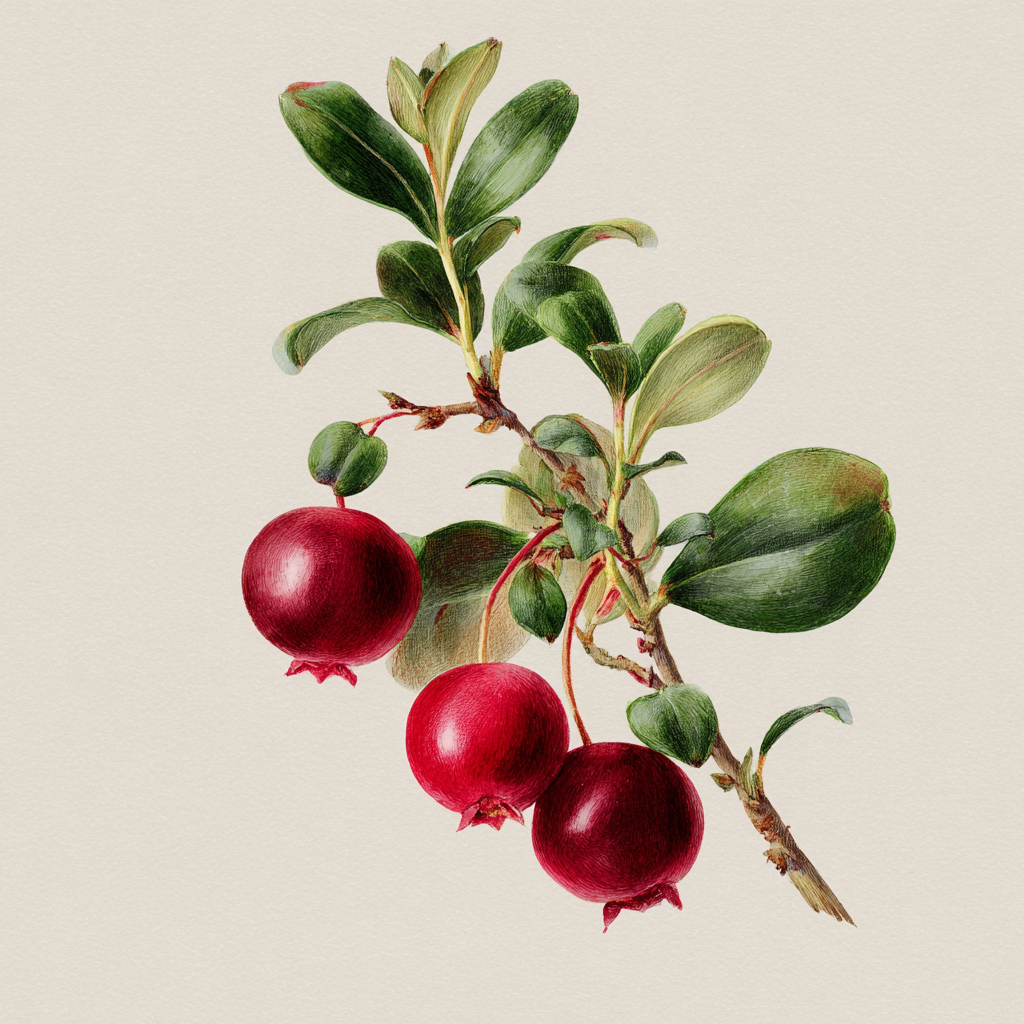
Cranberry
FruitVaccinium macrocarpon
Have seeds for this? Add to inventory →Cranberry is a low-growing, creeping native shrub of eastern North American bogs and wetlands, producing the familiar tart red berries of Thanksgiving tradition. A member of the heath family alongside blueberry and lingonberry, cranberry requires very acidic, consistently moist soil and full sun. In the garden it forms a beautiful low groundcover of small evergreen leaves studded with pink flowers in summer and vivid red berries in autumn. It is best suited to bog gardens, raised acid beds, or large containers with specialist acidic planting mix.
Growing Conditions
Growing Conditions
Sunlight
Full Sun
Water Needs
High
Soil
Very acidic, peaty, consistently moist to wet soil; pH 4.0 - 5.0; does not tolerate neutral or alkaline soil
Spacing
12 - 18 inches; creeping stems root as they spread
Days to Maturity
First harvest in year 2 - 3; full production from established planting
Growing Zones
Growing Zones
Thrives in USDA Zones 3 - 7
When to Plant
When to Plant
Transplant
Plant rooted cuttings or plugs in spring in prepared acidic bog bed; keep soil consistently wet after planting
Harvest
Harvest when berries turn deep red in September - November; pick by hand or rake; berries store well in cool conditions
Phenology (Natural Timing Cues)
Transplant
Plant in spring once frost danger passes, in a prepared acidic planting area with consistent moisture. Cranberry establishment is slow but the plant is very long-lived once established.
- Hard frost danger has passed.
- Soil is consistently moist and acidic planting area is prepared.
- Forsythia has bloomed and soil temperature is above 45°F.
Start Dates (Your Location)
Average dates use your saved zone; readiness also checks your forecast when available.
Best Planting Window
Spring window
Spring
Plant early enough for roots to settle before summer heat.
Autumn window
Usually skip autumn planting
Use spring unless you have locally grown nursery stock and enough mild weather for roots to establish.
Planting Method
Plant nursery-grown cranberry stock or rooted cuttings. Seed-grown plants are slow, variable, and usually not the best way to establish a productive planting.
Critical Timing Note
Plant after cold risk has passed so roots can establish without chilling or stalling.
Use the average timing, but check your local forecast before planting.
Typical Harvest Window
September to November
Organic Growing Tips
Organic Growing Tips
Prepare a proper acidic bog bed before planting; no amount of aftercare compensates for wrong soil pH.
Flood the bed or fill a lined bog trench with water in late autumn to protect overwintering plants from desiccation.
Apply fresh sphagnum moss as a topdressing each spring to help hold moisture and protect the bog-style surface cranberries prefer.
Renovate overly dense mats every 4 - 5 years by raking or mowing in spring to encourage new productive growth.
Net the bed in September as berries colour to protect from birds.
Care Guidance
Optional seasonal guidance for what you can do, even when nothing is urgent.
Care Guidance
Watering
During active growth and extended dry periods, this plant often benefits from steadier moisture. If the top inch dries out, a slow deep watering at the base is often enough.
Feeding
Extra feeding is rarely required if soil is healthy. If growth looks pale or slow, a light compost top-dressing is often enough before adding anything stronger.
Pruning
If pruning is needed, dormancy or the period just after harvest is often the simplest window. Dead, damaged, or crossing growth is usually the first place to start.
Seasonal care
In late fall, a light cleanup and fresh mulch can help if winter protection is useful in your climate. Leaving a little space around crowns and trunks often helps air move and keeps excess moisture from sitting there.
Known Varieties
Common cultivars worth knowing
Known Varieties
Stevens
The most widely planted commercial cranberry variety; large berries and high yields on vigorous upright vines; good for home bog plantings.
Best for
General production, large bog plantings
Ben Lear
Early-ripening variety with deep red colour; suited to cooler, shorter-season climates.
Best for
Cold climates, early harvest
Pilgrim
Large-berried variety with excellent flavour; named for its New England heritage.
Best for
Fresh eating, fresh flavour quality
Companion Planting
Companion Planting
Good companions
- Blueberry
- Lingonberry
- Pitcher Plant
- Labrador Tea
- Sphagnum Moss
Avoid planting near
No known conflicts
Common Pests
Common Pests
- Cranberry Fruitworm
- Blueberry Maggot
- Powdery Mildew
- Mummyberry Fungus
All pest management in Garden uses safe, organic, non-toxic methods only. No synthetic pesticides, ever.
Simple Ways to Use
Simple Ways to Use
Start here if you're not sure how to use this crop in the kitchen.
Quick recipes you can make right away
Simple Cranberry Sauce
Simmer cranberries with water and sugar for 8 to 12 minutes until most berries pop and the sauce thickens enough to coat a spoon. Stop while it still looks a little loose, because it firms up more as it cools.
Cranberry Muffin Stir-In
Fold whole or chopped cranberries into muffin batter just before baking so the berries stay evenly spread instead of sinking. Use sugar in the batter or topping, because cranberries are very tart when left plain.
Cranberry Juice Base
Simmer the berries in water until they burst and the liquid turns deep red, then strain and sweeten to taste. Chill it before serving, because warm unsweetened cranberry juice tastes much sharper.
How to Preserve
How to Preserve
Use this section to store or process extra harvest before it spoils.
Practical methods for extra harvest
Freeze whole cranberries
Rinse and dry the berries well, spread them on a tray, and freeze until hard before bagging them so they stay loose. Use them frozen for sauce, baking, or juice, because thawed cranberries are best cooked rather than served fresh.
Freeze cooked sauce
Cook cranberry sauce fully, cool it completely, and freeze it in small containers with a little headspace. Freeze it in serving-size portions so you can thaw only what you need.
Make cranberry jelly or preserves
Cook cranberries with sugar until the berries burst and the mixture thickens, or strain for jelly if you want a smooth finish. Water-bath can it only with a tested recipe and the full processing time for your jars and altitude.
New to preserving food?
New to canning? Read the safe canning guide.New to freezing? Read the freezing guide.How to Store
How to Store
Simple storage tips
Keep cranberries refrigerated and use them within about 2 to 4 weeks if they were sound and dry when stored.
Store them dry in a bag or container with a little airflow so extra moisture does not collect around the berries.
Use soft or split berries first, because good cranberries should feel firm and bounce slightly when dropped.
Do not wash them before storage unless necessary, because extra surface moisture speeds mold.
Freeze extra berries promptly if you will not use them soon, because cranberries freeze very well with little prep.
How to Save Seed
How to Save Seed
Step-by-step seed saving
- 1
Cranberry seed is not the practical way to keep the same named variety, because selected cranberries are usually propagated vegetatively and seedlings vary from the parent.
- 2
If you want more of the same cranberry, use runners, cuttings, or nursery stock from that selection instead of planting saved seed.
- 3
Seeds can be saved only for breeding or experimentation, not for keeping a named cranberry true to type.
Native Range
Native Range
- Origin
- Native to eastern North America, from Newfoundland south to the Atlantic and Gulf coastal plain and inland to the Great Lakes.
- Native Habitat
- Sphagnum bogs, peat wetlands, acidic lake margins, and open wet heathland; requires very acidic, waterlogged, low-nutrient soils.
- Current Distribution
- Native range largely intact in protected wetlands; commercially cultivated in flooded bogs in Massachusetts, Wisconsin, Washington, Oregon, and British Columbia.
Taxonomy
Taxonomy
- Kingdom
- Plantae
- Family
- Heath family (Ericaceae)
- Genus
- Vaccinium
- Species
- macrocarpon
Morphology
Morphology
Root System
Very shallow, fibrous root system dependent on moist, acidic, low-nutrient peat or sphagnum conditions; roots associate with ericoid mycorrhizal fungi to extract nutrients from the acidic bog environment.
Stem
Slender, wiry, creeping woody stems forming a low mat 3 - 6 inches tall; stems root where they touch moist soil, spreading the colony outward.
Leaves
Small, alternate, oval evergreen leaves 0.3 - 0.6 inch long; dark green above, paler below; slightly rolled at the margins; persistent through winter, turning bronze in cold conditions.
Flowers
Small, reflexed, pink flowers with protruding stamens, resembling tiny shooting stars; produced on upright shoots in June - July; attractive to bumblebees.
Fruit
Round to oval berries 0.5 - 1 inch across, initially white, ripening to deep red in September - November; tart and firm; exceptionally high in benzoic acid, which acts as a natural preservative allowing raw berries to keep for months in cool storage.
Natural History
Natural History
Vaccinium macrocarpon, the large cranberry or American cranberry, is native to the sphagnum bogs and acidic wetlands of eastern North America, from Newfoundland to the Atlantic coastal plain south to North Carolina and inland to the Great Lakes. The cranberry is one of three commercially significant native North American fruits - alongside blueberry and Concord grape - and is the largest agricultural crop in Massachusetts, Wisconsin, New Jersey, Oregon, and Washington State, as well as British Columbia. Indigenous peoples of eastern North America, including the Wampanoag, Haudenosaunee, Ojibwe, and Mi'kmaq, gathered and used wild cranberries for food, dye, and medicine for thousands of years before European contact. The Wampanoag name for cranberry, sasemineash, was documented in early colonial records, and the fruit was incorporated into pemmican by multiple nations. European settlers quickly recognized and adopted cranberry as a food, and by the 18th century it was traded commercially from New England ports to Europe. The commercial cultivation of cranberry in flooded bog systems - the familiar image of flooded red-carpeted bogs at harvest time - began in the early 19th century in Massachusetts and represents one of the oldest continuous native plant domestication industries in North America. The berry's exceptional keeping quality when raw, owing to its high benzoic acid content, made it a practical food for sea voyages and long winters and drove its early commercial value.
Traditional Use
Traditional Use
Cranberry has one of the most extensively documented traditional and modern medicinal uses of any North American native fruit. Indigenous peoples used it as food, dye, and medicine; colonial and early American medicine adopted it as a preservative, food, and remedy; and the 20th century produced substantial scientific interest in cranberry extract for urinary tract health, culminating in a large body of clinical research. The modern understanding of cranberry's proanthocyanidins (PACs) as anti-adhesion compounds that prevent certain bacteria from attaching to urinary tract walls has given scientific context to the historical urinary tract use.
Parts Noted Historically
Wampanoag and Haudenosaunee peoples, northeastern North America - Berries
Wampanoag and Haudenosaunee ethnobotanical records document cranberry use as food and medicine. The berries were eaten raw, cooked, dried, and mixed into pemmican and other preserved foods. Poultice preparations from the berries were applied to wounds, reflecting the intuitive use of an acidic, antimicrobial fruit for topical applications. Internal use included preparations for urinary and kidney complaints, documented in multiple northeastern Indigenous nations' ethnobotanical records.
Colonial American and 18th - 19th century folk medicine - Berries and juice
Early American medical writers noted cranberry preparations as useful for stomach complaints, fevers, and urinary conditions. Cranberry sauce became a standard part of the American diet, and the fruit appeared in domestic medical manuals as a diuretic and urinary tract remedy throughout the 18th and 19th centuries. This tradition was consistent with Indigenous use and persisted into 20th-century folk medicine.
20th century clinical research, North America and Europe - Berries and standardized juice
From the 1980s onward, cranberry became the subject of clinical trials examining its effect on urinary tract infections (UTIs). Research identified proanthocyanidins (specifically type-A PACs) as the compounds responsible for preventing Escherichia coli and other bacteria from adhering to urinary tract epithelium. Meta-analyses of clinical trials show mixed results: cranberry appears to offer modest preventative benefit in recurrent UTIs in some populations, particularly in women with recurrent infections, but is not a treatment for active infections and should not replace prescribed antibiotics.
Cranberry is safe as food in any culinary quantity. Concentrated cranberry extract supplements or large volumes of cranberry juice may interact with warfarin (a blood thinner), potentially increasing anticoagulant effect; people on warfarin should consult a doctor before taking cranberry supplements in therapeutic doses. Cranberry juice should not be used as a substitute for prescribed antibiotic treatment for urinary tract infections.
This information is provided for historical and educational purposes only and is not medical advice. Always consult a qualified healthcare professional before making decisions related to your health.
Loading photo submission…