Culver's Root
FlowerVeronicastrum virginicum
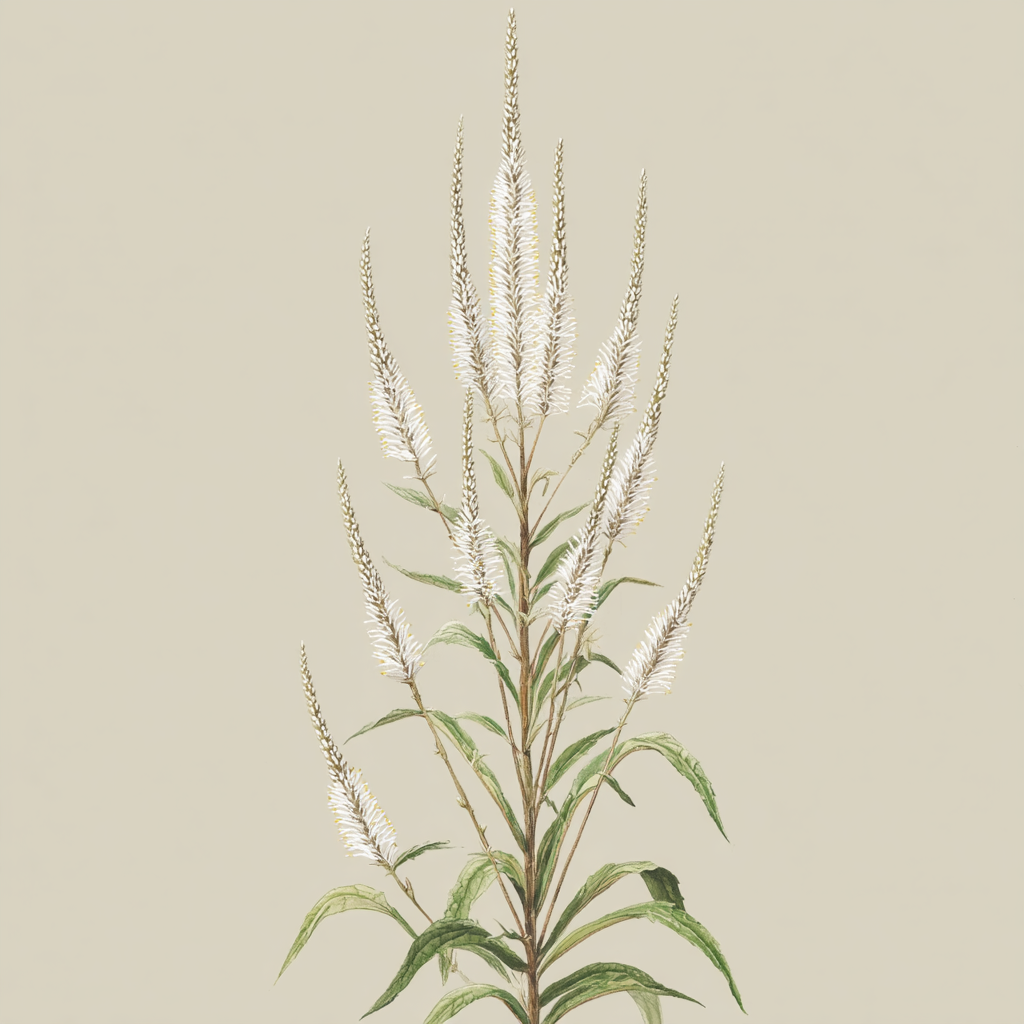
Have seeds for this? Add to inventory →Culver's Root is a stately native North American perennial prized for its tall, candelabra-like wands of tiny white to pale lavender flowers that attract a remarkable diversity of pollinators through midsummer. It grows naturally in moist prairies, open woodlands, and stream edges across eastern North America and brings both vertical structure and ecological value to the garden. Long-lived and clump-forming, it is a dependable backbone plant for rain gardens, pollinator borders, and naturalistic landscapes.
Growing Conditions
Growing Conditions
Sunlight
Full Sun to Partial Shade
Water Needs
Moderate
Soil
Moist, fertile, humus-rich loam; tolerates clay if drainage is reasonable; struggles in dry, compacted, or sandy soils
Spacing
24 to 36 inches
Days to Maturity
Blooms second year from seed; divisions and transplants typically bloom first season
Growing Zones
Growing Zones
Thrives in USDA Zones 3 - 9
When to Plant
When to Plant
Start Indoors
Start seed indoors 8-10 weeks before last frost; surface-sow and cold-stratify for 30-60 days before moving to warmth
Transplant
Set transplants or purchased divisions outdoors after last frost when soil has warmed, typically late spring
Direct Sow
Direct sow seed in fall for natural cold stratification and spring germination
Harvest
Cut flower spikes when one-third to one-half of the florets have opened for longest vase life; deadhead or leave spent spikes for late-season seed set and winter bird interest
Phenology (Natural Timing Cues)
Transplant
Culver's Root transplants best when the soil has warmed and settled after spring's coldest spells, giving roots time to establish before summer heat peaks. Setting plants too early into cold, waterlogged soil invites crown rot, while planting too late in summer shortens the establishment window and reduces first-year bloom potential. Wait for the garden to show reliable warm-season momentum before transplanting.
- Lilacs are in full bloom or beginning to fade
- Oak leaves are approaching full size
- Soil is consistently moist but draining cleanly after rain
- Tender annual weeds are germinating actively in beds
- Nights stay reliably above 45°F
Start Dates (Your Location)
Average dates use your saved zone; readiness also checks your forecast when available.
Average Last Frost
Set your growing zone to see personalized calendar dates.
Use the average timing, but check your local forecast before planting.
Direct Sow
Spring
Use the seasonal timing note for this plant.
Planting Method
Usually planted from divisions rather than started from seed.
Typical Harvest Window
July to September
Organic Growing Tips
Organic Growing Tips
Topdress established clumps with a 1-2 inch layer of finished compost each spring to maintain the moist, humus-rich conditions Culver's Root naturally prefers in prairie and woodland-edge soils
Apply 2-3 inches of shredded leaf or wood-chip mulch around the base to retain soil moisture, moderate temperature swings, and suppress weeds without smothering the crown
Water with compost tea once or twice during dry midsummer stretches to support soil biology and replace moisture lost during drought, as consistent soil moisture is critical during establishment
Avoid high-nitrogen fertilizers, which push rank, floppy growth; if feeding is needed, a dilute worm-casting drench in early spring gives a gentle, balanced boost
Divide clumps every 4-5 years in early spring when new growth is just emerging to rejuvenate vigor and increase plant stock; divisions reestablish quickly with good moisture
Interplant with deep-rooted prairie companions like prairie dropseed and wild bergamot to create a mutually supportive root zone that improves soil structure and reduces the need for supplemental irrigation
Care Guidance
Optional seasonal guidance for what you can do, even when nothing is urgent.
Care Guidance
Watering
If the top 2 inches of soil feel dry, a deep watering at the base may help more than frequent light watering. In healthy soil, rain may cover much of what it needs.
Feeding
Extra feeding is rarely required if soil is healthy. If growth looks pale or slow, a light compost top-dressing is often enough before adding anything stronger.
Seasonal care
In late fall, a light cleanup and fresh mulch can help if winter protection is useful in your climate. Leaving a little space around crowns and trunks often helps air move and keeps excess moisture from sitting there.
Harvest timing
Harvests often cluster around July to September. If fruit, leaves, or roots start looking ready, color, size, firmness, and scent usually tell you more than the calendar alone.
Known Varieties
Common cultivars worth knowing
Known Varieties
Veronicastrum virginicum 'Fascination'
A widely grown cultivar selected for its lavender-pink flower spikes rather than the typical white, offering a softer color palette while retaining full ornamental and pollinator value.
Best for
Mixed perennial borders where color contrast with other native wildflowers is desired
Veronicastrum virginicum 'Album'
A white-flowered selection with particularly clean, bright spikes that stand out well in evening or shade-margin settings; one of the most reliable straight-species-type cultivars available in the nursery trade.
Best for
White gardens, moon gardens, and naturalistic prairie plantings
Veronicastrum virginicum 'Lavendelturm'
A German-selected cultivar with soft lavender-blue flower spikes and notably sturdy stems that resist flopping even in partial shade; one of the tallest reliable forms at up to 6 feet.
Best for
Back-of-border use and tall naturalistic plantings where stem strength matters
Veronicastrum virginicum 'Diana'
A compact, white-flowered cultivar reaching 3-4 feet, well suited to smaller borders where the full-sized species would overwhelm neighbors.
Best for
Smaller rain gardens and mid-border positions where height control is needed
Companion Planting
Companion Planting
Good companions
Support & insectary plants
Nearby plants that attract pollinators, beneficial insects, or improve soil health.
- Echinacea
Attracts pollinators and beneficial insects
- Joe Pye Weed
Attracts pollinators and beneficial insects
- Ironweed
Attracts pollinators
- Black-eyed Susan
Attracts pollinators and beneficial insects
- Wild Bergamot
Attracts pollinators and beneficial insects
- New England Aster
Attracts pollinators
Avoid planting near
No known conflicts
Common Pests
Common Pests
All pest management in Garden uses safe, organic, non-toxic methods only. No synthetic pesticides, ever.
Native Range
Native Range
- Origin
- Native to eastern North America.
- Native Habitat
- Moist prairies, open woodlands, stream banks, and wet meadows across eastern and central North America.
- Current Distribution
- Eastern and central North America; a staple of native plant and rain gardens for its tall white flower spikes and exceptional value to native bees.
Taxonomy
Taxonomy
- Kingdom
- Plantae
- Family
- Plantain family (Plantaginaceae)
- Genus
- Veronicastrum
- Species
- virginicum
Morphology
Morphology
Root System
Culver's Root develops a deep, fibrous root system anchored by a short, knotty rhizome that spreads slowly to form clumps; the root crown is tough and persistent, supporting decades of growth without becoming invasive.
Stem
Stems are erect, unbranched, and can reach 3-6 feet tall, forming an impressive vertical presence in the border; the whorled leaf arrangement along the stem is the plant's most distinctive vegetative identification feature.
Leaves
Leaves are arranged in whorls of 3-7 around each stem node, lance-shaped with finely serrated margins; yellowing or wilting leaves during establishment signal insufficient soil moisture rather than disease.
Flowers
Flowers are produced in multiple slender terminal racemes arranged in a candelabra pattern atop each stem, opening progressively from the base upward over several weeks in mid to late summer, providing an extended bloom period highly attractive to bumblebees, native bees, and butterflies.
Fruit
Spent flower spikes produce small capsules containing fine seed; leaving spikes standing through winter provides modest bird interest and allows self-seeding, though seedlings may not appear in abundance without natural cold stratification.
Natural History
Natural History
Veronicastrum virginicum is native to moist prairies, rich open woodlands, and stream-bank margins of eastern and central North America, ranging from Manitoba south through the Great Plains and east to the Atlantic seaboard. The genus name means 'resembling Veronica,' to which it was long assigned before molecular work established it as a distinct lineage. The common name honors Dr. Coulvert, an early American physician associated with its medicinal use. As a prairie plant, it co-evolved with bumblebees and long-tongued native bees whose weight flexes its tiny tubular florets open, making it a specialist-pollinator plant with measurable ecological value beyond general ornamental use.
Traditional Use
Traditional Use
Several Indigenous peoples of eastern North America documented historical uses of Culver's Root root, particularly as a strong cathartic and liver-acting agent. European settler physicians of the 18th and 19th centuries, including Eclectic medical practitioners, adopted root preparations into their materia medica under the name 'Leptandra' and recorded it as one of the more powerful botanical agents in their repertoire. Its use declined through the late 19th century as its potency made dosing unreliable outside experienced practice.
Parts Noted Historically
Meskwaki and other Great Lakes Indigenous peoples - root
Historical ethnobotanical records document Meskwaki use of the root as a strong purgative, particularly associated with cleansing rituals and treatment of serious internal complaints.
American Eclectic medicine, 18th-19th century - dried root
Eclectic physicians catalogued dried Culver's Root under 'Leptandra virginica' in their materia medica, describing it as a powerful hepatic and cathartic agent used in cases of bilious fever and torpid liver conditions.
Early American folk medicine - root
The plant acquired the name 'Bowman's root' and 'black root' in early American vernacular medicine, where root preparations were associated with forceful purgative effects, making it a plant known for dramatic and sometimes dangerous action.
Fresh Culver's Root root is considered toxic and strongly irritating; historical sources consistently noted that fresh root caused violent purging and that only dried root was used in historical practice. All parts of the plant should be treated as toxic if eaten. This is a garden ornamental and pollinator plant, not a foraging plant.
This information is provided for historical and educational purposes only and is not medical advice. Always consult a qualified healthcare professional before making decisions related to your health.
Loading photo submission…