Currant
FruitRibes americanum
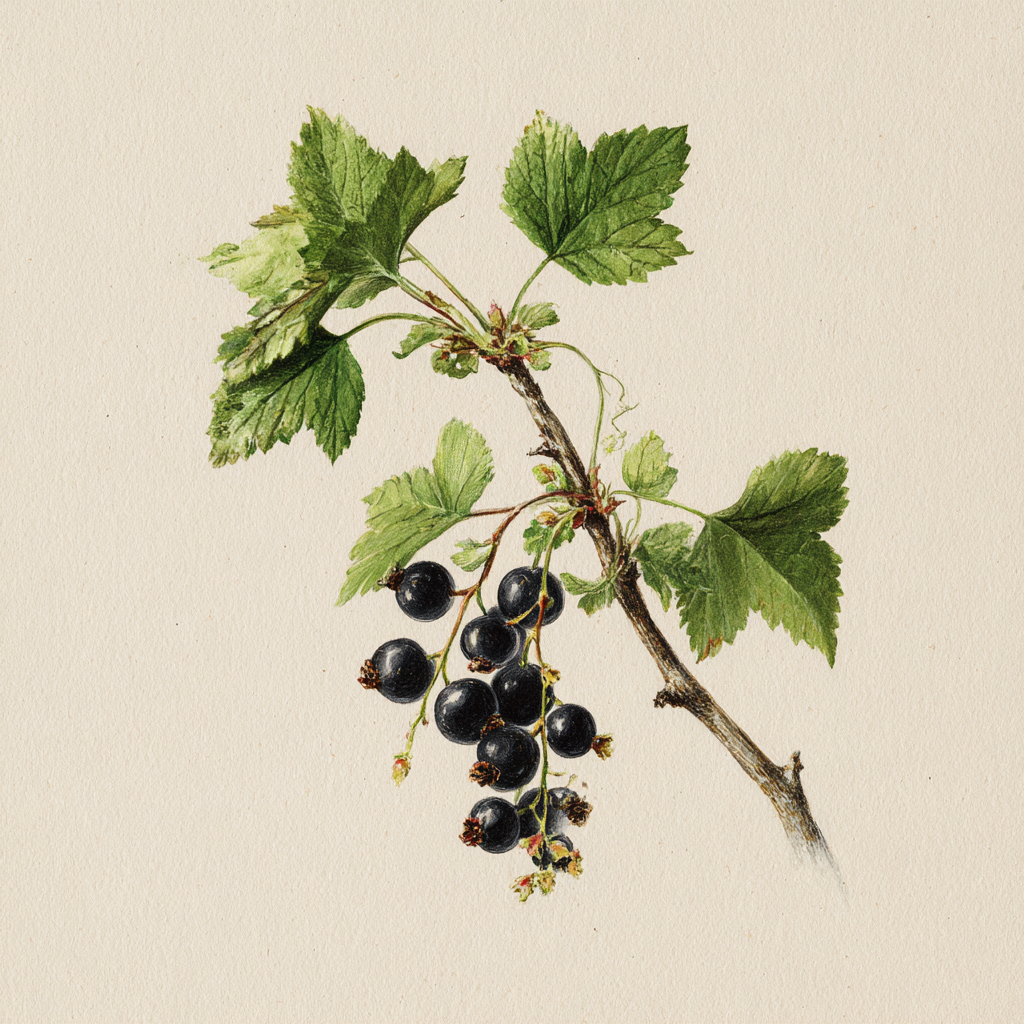
Have seeds for this? Add to inventory →American black currant is a hardy, cold-tolerant fruiting shrub prized for its clusters of dark, aromatic berries and exceptional vitamin C content. Native to moist woodlands across North America, it thrives in temperate gardens with minimal inputs and rewards patient growers with generous harvests starting in its second or third year. Its deeply lobed leaves, resinous fragrance, and tolerance for partial shade make it one of the most versatile fruiting shrubs for home gardens.
Growing Conditions
Growing Conditions
Sunlight
Full Sun to Partial Shade
Water Needs
Moderate
Soil
Moist, well-drained, humus-rich loam with moderate fertility; tolerates heavier soils if not waterlogged
Spacing
48 to 60 inches
Days to Maturity
2 to 3 years to first significant harvest; berries ripen 90–110 days after bloom
Growing Zones
Growing Zones
Thrives in USDA Zones 3 - 7
When to Plant
When to Plant
Transplant
Plant bare-root or container stock in early spring while dormant, or in fall 4–6 weeks before hard frost
Harvest
Harvest when berry clusters are fully dark and slightly soft, typically midsummer; pick entire clusters by hand or with a fork; berries hold on the bush for 2–3 weeks without dropping
Phenology (Natural Timing Cues)
Transplant
Plant currant bare-root or container stock while the shrub is dormant to give roots maximum time to establish before summer heat. Spring planting should happen as soon as soil is workable and night temperatures stay above hard-freeze thresholds; fall planting works well in zones 4–6 if done early enough for root establishment before freeze. Planting into dry or frozen soil delays establishment significantly and increases transplant stress.
- Forsythia finishing bloom and soil workable 4–6 inches deep
- Lilac buds swelling but not yet leafing out
- Overnight lows consistently above 20°F and no hard freeze forecast within two weeks
- For fall planting: leaf drop beginning on nearby deciduous trees, soil still pliable
Start Dates (Your Location)
Average dates use your saved zone; readiness also checks your forecast when available.
Best Planting Window
Spring window
Early spring
Plant as soon as the soil is workable so roots establish before heat arrives.
Autumn window
Usually skip autumn planting
Use spring unless you have locally grown nursery stock and enough mild weather for roots to establish.
Planting Method
Plant nursery-grown currant stock or rooted cuttings. Seed-grown plants are slow, variable, and usually not the best way to establish a productive planting.
Critical Timing Note
Plant while dormant and before bud break so roots establish before leaves demand water.
Use the average timing, but check your local forecast before planting.
Typical Harvest Window
June to August
Organic Growing Tips
Organic Growing Tips
Top-dress with finished compost or worm castings each spring before bud break to support fruit development without promoting excessive vegetative growth
Apply a 3–4 inch layer of wood chip or straw mulch around the root zone to retain moisture, suppress weeds, and gradually build organic matter
Brew comfrey tea or use diluted comfrey leaf mulch as a potassium-rich feed during fruit set to improve berry size and flavor
Prune out canes older than three years each late winter to keep the shrub productive; old wood produces little fruit and shades out vigorous younger canes
Encourage ground beetles and predatory wasps by planting yarrow and chives nearby; these beneficials help manage aphid and sawfly populations organically
If powdery mildew appears, improve air circulation by thinning crowded canes and apply a diluted neem oil or baking soda spray as a preventive botanical treatment
Care Guidance
Optional seasonal guidance for what you can do, even when nothing is urgent.
Care Guidance
Watering
If the top 2 inches of soil feel dry, a deep watering at the base may help more than frequent light watering. In healthy soil, rain may cover much of what it needs.
Feeding
If growth is strong, compost-rich soil often carries most of the load. If the plant starts looking pale or stalls, a light compost top-dressing or gentle organic feed may help.
Pruning
If pruning is needed, dormancy or the period just after harvest is often the simplest window. Dead, damaged, or crossing growth is usually the first place to start.
Seasonal care
In late fall, a light cleanup and fresh mulch can help if winter protection is useful in your climate. Leaving a little space around crowns and trunks often helps air move and keeps excess moisture from sitting there.
Pollination & Fruit Production
Pollination & Fruit Production
The pollination helper includes compatibility guidance for currant.
Need a compatible partner? Open the Fruit Tree Planner.Known Varieties
Common cultivars worth knowing
Known Varieties
- Ribes nigrum 'Consort'
European black currant cultivar bred with resistance to white pine blister rust, making it legal to grow in many formerly restricted states; very productive with large, intensely flavored berries
Best for
Regions with blister rust restrictions; jams, juices, and cordials
- Ribes nigrum 'Ben Sarek'
Compact Scottish cultivar reaching only 3–4 feet, with heavy crops of large berries on a shrub suitable for small gardens and partial shade
Best for
Small gardens, container planting, fresh eating and preserves
- Ribes rubrum 'Red Lake'
Reliable American red currant cultivar with long clusters of bright red, mildly tart berries; easier to grow than black currants and highly ornamental when fruiting
Best for
Fresh eating, jellies, and ornamental edible landscapes
- Ribes sativum 'White Imperial'
White currant with translucent, amber-pink berries notably sweeter and less acidic than red or black types; valued for fresh eating and elegant jellies
Best for
Fresh eating and gourmet preserves
Companion Planting
Companion Planting
Support & insectary plants
Nearby plants that attract pollinators, beneficial insects, or improve soil health.
Avoid planting near
- white pine
- eastern white pine
- gooseberry (near white pine)
Common Pests
Common Pests
- currant aphid
- imported currantworm
- currant fruit fly
- spider mites
- four-lined plant bug
- white pine blister rust (fungal)
All pest management in Garden uses safe, organic, non-toxic methods only. No synthetic pesticides, ever.
Simple Ways to Use
Simple Ways to Use
Start here if you're not sure how to use this crop in the kitchen.
Quick recipes you can make right away
Fresh Currant Bowl
Strip ripe currants from the stems and chill them for 15 to 20 minutes if you want them firmer and cooler. Eat them once the berries look glossy and taste fully ripe, because underripe currants can be much sharper than ripe ones.
Quick Currant Sauce
Simmer currants with a little sugar and a splash of water for 5 to 8 minutes until the berries burst and the juice thickens slightly. Stop while the sauce still pours, because it sets a little more as it cools.
Currant Tart Filling
Cook the berries with sugar for a few minutes, then stir in a little starch and simmer until the juices turn glossy and lightly thickened. Cool the filling until warm rather than hot before adding it to pastry so the crust does not turn soggy.
How to Preserve
How to Preserve
Use this section to store or process extra harvest before it spoils.
Practical methods for extra harvest
Freeze currants on the stem or off
Rinse and dry the currants well, then freeze them on their stems or stripped into a single layer until hard before bagging. Use them frozen for baking, sauce, or jam, because thawed berries soften too much for a neat fresh bowl.
Make currant jelly
Simmer the berries with a little water until they release plenty of juice, then strain and cook the juice with sugar using a tested jelly recipe until it reaches the proper gel point. Water-bath can it only with a tested recipe and the full processing time for your jars and altitude.
Make currant syrup
Cook the berries until they burst, strain the juice, and simmer it with sugar until the liquid thickens just enough to lightly coat a spoon. Cool it before bottling, and refrigerate or freeze small batches unless you are following a tested canning recipe.
New to preserving food?
New to canning? Read the safe canning guide.New to freezing? Read the freezing guide.How to Store
How to Store
Simple storage tips
Keep currants cold in the refrigerator and use them within about 3 to 5 days, because the berries soften quickly once picked.
Store them dry in a shallow container so the fruit underneath does not get crushed.
Leave the berries on their strings until you are ready to use them if you can, because stripped berries lose moisture faster.
Wash currants only before using them, because extra surface moisture speeds mold.
Use any leaking or moldy clusters first or discard them, because spoilage spreads fast through tightly packed berries.
How to Save Seed
How to Save Seed
Step-by-step seed saving
- 1
Currants are usually kept true from hardwood cuttings, not from seed, because seed-grown plants can vary from the parent.
- 2
If you want more of the same currant, root a healthy cutting during dormancy instead of saving seed.
- 3
Save seed only for breeding or experimentation, not for keeping a named currant true to type.
Native Range
Native Range
- Origin
- Native to North America.
- Native Habitat
- Moist woodland edges, stream banks, and partially shaded sites.
- Current Distribution
- Northern and central North America; commonly grown in temperate gardens.
Taxonomy
Taxonomy
- Kingdom
- Plantae
- Family
- Gooseberry family (Grossulariaceae)
- Genus
- Ribes
- Species
- americanum
Morphology
Morphology
Root System
Fibrous, shallow to moderately deep root system spreading 2–3 feet from the crown; plant in well-amended soil with consistent moisture as roots do not penetrate compacted or poorly drained subsoil effectively
Stem
Multi-stemmed shrub producing new basal canes each year; canes are most productive in years two and three and should be pruned out at the base after year three to keep fruiting wood young and vigorous
Leaves
Deeply three- to five-lobed, maple-like leaves with a faintly resinous or musky scent when bruised; yellowing or curling leaves in summer often signal currant aphid feeding on the undersides
Flowers
Small, tubular, pale greenish-white flowers appear in drooping racemes in early spring before leaves fully expand; flowers attract early bumblebees and native pollinators essential for fruit set
Fruit
Berries ripen in pendant clusters from green to fully glossy black; harvest when the entire cluster is uniformly dark and berries yield slightly to gentle pressure, as underripe currants are tart and poorly flavored for fresh eating but acceptable for preserves
Natural History
Natural History
Ribes americanum is native to moist woodlands, stream margins, and forest edges across central and eastern North America, ranging from New Brunswick to Virginia and west to the Great Plains. Unlike European black currant (Ribes nigrum), which dominated Old World cultivation and trade, the American species remained largely a foraged and locally cultivated fruit among Indigenous nations for generations before European settlers recognized its value. In the early twentieth century, currant cultivation across North America was suppressed by a federal ban enacted in 1911 to protect the lumber industry from white pine blister rust, a fungal pathogen that uses Ribes as an alternate host; the ban was lifted federally in 1966 but persisted in some states. Currants fruit on second- and third-year wood, making annual pruning directly responsible for productivity.
Traditional Use
Traditional Use
Indigenous peoples across the eastern and central regions of North America documented using Ribes americanum berries, bark, and roots for a range of purposes recorded by ethnobotanists in the nineteenth and twentieth centuries. The Ojibwe, Potawatomi, and other Great Lakes nations recorded uses of currant bark and root preparations in historical ethnobotanical surveys. European settlers and later American folk practitioners adopted the berries primarily as a high-vitamin food source, with documented interest in leaf and berry preparations recorded in nineteenth-century herbal texts.
Parts Noted Historically
Ojibwe and Potawatomi peoples, Great Lakes region, documented 19th–20th century ethnobotany - bark and root
Ethnobotanical records compiled by Huron Smith and others in the 1920s–1930s document Ojibwe and Potawatomi peoples noting uses of Ribes bark and root preparations for kidney and urinary complaints, recorded as observational data in the context of traditional plant knowledge surveys
North American folk herbal tradition, 19th century - berries and leaves
Nineteenth-century American herbal writers noted the high astringency of currant leaves and the tart, vitamin-rich berries as valued in rural domestic practice, primarily as food medicine in the context of seasonal berry harvests and preserved fruit stores
Ripe berries of Ribes americanum are edible and widely consumed; raw berries in very large quantities may cause mild gastric upset in sensitive individuals. The plant is not considered toxic, but stems, unripe berries, and leaves are not used as food. Ribes species can harbor white pine blister rust and are regulated in some states.
This information is provided for historical and educational purposes only and is not medical advice. Always consult a qualified healthcare professional before making decisions related to your health.
Loading photo submission…