Flowering Dogwood
FlowerCornus florida
Have seeds for this? Add to inventory →Flowering Dogwood is a beloved native ornamental tree celebrated for its showy spring bracts, brilliant fall foliage, and bright red berries that feed wildlife into winter. It thrives at woodland edges and in dappled shade, making it an exceptional choice for naturalistic gardens and understory plantings. Few small trees rival its four-season interest or its value to native pollinators and songbirds.
Growing Conditions
Growing Conditions
Sunlight
Full Sun to Partial Shade
Water Needs
Moderate
Soil
Moist, well-drained, humus-rich, slightly acidic soil; does not tolerate compaction or waterlogging
Spacing
180 to 300 inches
Days to Maturity
3 to 5 years to first significant bloom from nursery transplant
Growing Zones
Growing Zones
Thrives in USDA Zones 5 - 9
When to Plant
When to Plant
Transplant
Plant balled-and-burlapped or container nursery stock in early spring before bud break, or in early fall at least 6 weeks before first frost
Harvest
Ornamental; harvest cut branches with buds in late winter for forcing indoors, or gather ripe red berries in autumn for wildlife or propagation
Phenology (Natural Timing Cues)
Transplant
Timing transplanting to early spring before buds break gives roots the entire growing season to establish before summer heat stress. Fall planting is also viable when done early enough for root establishment before freeze. Trees planted late into summer or during heat stress often drop leaves and struggle; moist, overcast weather at planting dramatically improves survival.
- Forsythia in bloom signals safe early-spring planting windows
- Tree buds swelling but not yet breaking open is the ideal spring transplant moment
- Soil workable and draining cleanly after winter freeze
- Nighttime temperatures reliably above 28°F for fall planting
- Leaves fully dropped and trees dormant for late-fall bare-root establishment
Start Dates (Your Location)
Average dates use your saved zone; readiness also checks your forecast when available.
Best Planting Window
Spring window
Early spring
Plant as soon as the soil is workable so roots establish before heat arrives.
Autumn window
Usually skip autumn planting
Use spring unless you have locally grown nursery stock and enough mild weather for roots to establish.
Planting Method
Plant nursery-grown transplants. They establish faster and more reliably than starting this plant from seed.
Critical Timing Note
Plant while dormant and before bud break so roots establish before leaves demand water.
Use the average timing, but check your local forecast before planting.
Typical Harvest Window
March, April, May, October, November
Organic Growing Tips
Organic Growing Tips
Apply a 3–4 inch layer of shredded leaf or wood chip mulch annually over the root zone to retain moisture, moderate soil temperature, and slowly build the humus layer dogwoods naturally favor
Top-dress with finished compost each spring rather than fertilizing; excess nitrogen encourages soft growth susceptible to powdery mildew and borers
Brew a dilute compost tea and drench the root zone in early spring to stimulate beneficial soil biology and support the mycorrhizal associations dogwoods depend on for nutrient uptake
Avoid any soil disturbance or cultivation beneath the canopy; shallow roots are easily damaged and the wound sites invite dogwood borer
Plant native groundcovers such as wild ginger or native ferns beneath the canopy instead of turf to eliminate the need for string trimming near the trunk, a leading injury vector for borers
If powdery mildew is recurrent, improve air circulation through light canopy thinning and select resistant cultivars like 'Appalachian Spring' for future plantings
Care Guidance
Optional seasonal guidance for what you can do, even when nothing is urgent.
Care Guidance
Watering
If the top 2 inches of soil feel dry, a deep watering at the base may help more than frequent light watering. In healthy soil, rain may cover much of what it needs.
Feeding
If growth is strong, compost-rich soil often carries most of the load. If the plant starts looking pale or stalls, a light compost top-dressing or gentle organic feed may help.
Pruning
If pruning is needed, dormancy or the period just after harvest is often the simplest window. Dead, damaged, or crossing growth is usually the first place to start.
Seasonal care
In late fall, a light cleanup and fresh mulch can help if winter protection is useful in your climate. Leaving a little space around crowns and trunks often helps air move and keeps excess moisture from sitting there.
Known Varieties
Common cultivars worth knowing
Known Varieties
Appalachian Spring
A University of Tennessee introduction with notably strong resistance to dogwood anthracnose, the fungal disease that has decimated wild populations; white bracts and good fall color
Best for
Humid regions where anthracnose is a persistent problem
Cherokee Princess
One of the most widely planted white-bracted cultivars, valued for large, overlapping bracts and reliable heavy bloom even on young trees
Best for
General ornamental use and landscape planting
Cherokee Chief
A deep rose-red to ruby bract cultivar with reddish new foliage; one of the most reliably colorful of the pink-flowered selections
Best for
Color contrast plantings and focal specimen trees
Stellar Pink
A Cornus florida × Cornus kousa hybrid with improved anthracnose resistance, pink bracts, and better heat and drought tolerance than straight Cornus florida
Best for
Zones 7–9 where heat stress and anthracnose pressure are both high
Rainbow
A variegated-leaf cultivar with creamy white and green foliage that turns rose-red in fall; slower growing than the species and best in partial shade to prevent leaf scorch
Best for
Collectors and gardeners seeking four-season foliage interest
Companion Planting
Companion Planting
Good companions
- Wild Ginger
- Native Ferns
- Oakleaf Hydrangea
- Trillium
- Solomon's Seal
Support & insectary plants
Nearby plants that attract pollinators, beneficial insects, or improve soil health.
- Eastern Redbud
Attracts pollinators
- Serviceberry
Attracts pollinators
Avoid planting near
- Black Walnut
Produces juglone, a soil-borne chemical toxic to many garden plants
- Turf Grass
Common Pests
Common Pests
- Dogwood Borer
- Scale Insects
- Dogwood Club-gall Midge
- Leaf Miners
- Aphids
- Powdery Mildew
- Dogwood Anthracnose
- Spot Anthracnose
- Crown Canker
All pest management in Garden uses safe, organic, non-toxic methods only. No synthetic pesticides, ever.
Native Range
Native Range
- Origin
- Native to eastern North America.
- Native Habitat
- Understory of deciduous forests, woodland edges, and moist slopes across eastern North America.
- Current Distribution
- Eastern North America; one of the most widely planted native ornamental trees, valued for spring flowers, fall color, and berry-producing wildlife habitat.
Taxonomy
Taxonomy
- Kingdom
- Plantae
- Family
- Dogwood Family (Cornaceae)
- Genus
- Cornus
- Species
- florida
Morphology
Morphology
Root System
Shallow, wide-spreading fibrous roots that extend well beyond the drip line; highly sensitive to soil compaction, grade changes, and drought, making the area beneath the canopy a no-disturb zone for growers
Stem
A single-trunked small tree with a layered, horizontal branching habit reaching 15–30 feet; the attractive exfoliating bark on mature trunks provides winter interest, and crossing or rubbing branches should be removed in late winter to maintain structure
Leaves
Opposite, ovate leaves with strongly arcuate veins that run parallel to the leaf margin - quick identification feature; leaves turn scarlet to burgundy in fall, and premature yellowing or browning in summer signals drought stress or root damage
Flowers
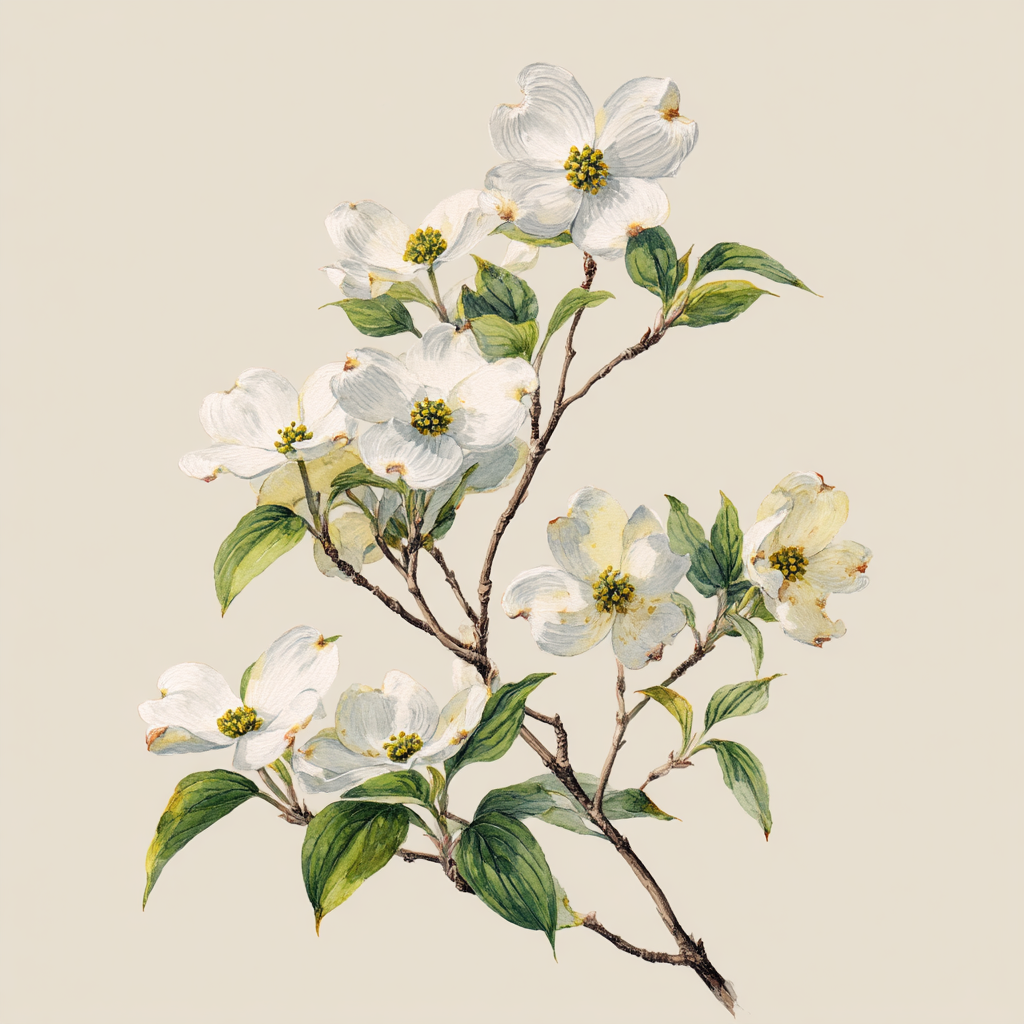
What appear to be four white or pink petals are actually showy bracts surrounding a tight cluster of inconspicuous true flowers in the center; bracts attract early pollinators including native bees and butterflies, and pollen production is important for beneficial insects emerging in early spring
Fruit
Clusters of glossy, ovoid red drupes ripen in early autumn and are eagerly consumed by migratory thrushes, waxwings, and other songbirds; seeds within the drupes require double dormancy stratification and are not viable for casual direct sowing
Natural History
Natural History
Cornus florida is native to the deciduous forests of eastern North America, ranging from southern Maine to northern Florida and west to the Great Plains margin. It evolved as a woodland understory tree, flourishing beneath oaks and hickories where dappled light and rich leaf-litter soils prevailed. The genus name Cornus derives from the Latin for horn, referencing the hardness of the wood, which was historically prized for tool handles, spindles, and weaving shuttles. Cherokee, Iroquois, and other eastern Indigenous peoples documented extensive uses of bark and root. For growers, understanding its understory origin explains why it resents compacted soils, full midday sun in hot climates, and the root competition of lawn grasses.
Traditional Use
Traditional Use
Eastern North American Indigenous peoples, including Cherokee and Iroquois communities, documented uses of Cornus florida bark and root in historical ethnobotanical records. The bark was particularly noted in 19th-century American materia medica as a substitute for Cinchona bark during quinine shortages. Historical records reflect a range of ceremonial, practical, and botanical applications across multiple cultures.
Parts Noted Historically
Cherokee (eastern North America, pre-contact through 19th century) - root bark
Cherokee ethnobotanical records documented the root bark of Cornus florida as an ingredient in preparations associated with fevers; the tree also held significance in ceremonial contexts documented by early ethnographers
American eclectic medicine (United States, 19th century) - bark
During the American Civil War and earlier periods of Cinchona shortage, physicians of the eclectic school documented Cornus florida bark as a tonic bitter and fever-tree substitute, described in publications including the King's American Dispensatory
Iroquois (northeastern North America) - twigs
Iroquois records documented the use of frayed dogwood twigs as a tooth-cleaning implement and noted bark preparations associated with skin conditions in several historical ethnobotanical surveys
The berries of Cornus florida are considered mildly toxic to humans and may cause vomiting if eaten in quantity, though they are consumed safely by birds; the bark contains tannins and cornine alkaloid that may cause irritation in sensitive individuals
This information is provided for historical and educational purposes only and is not medical advice. Always consult a qualified healthcare professional before making decisions related to your health.
Loading photo submission…