Foxglove
FlowerDigitalis purpurea
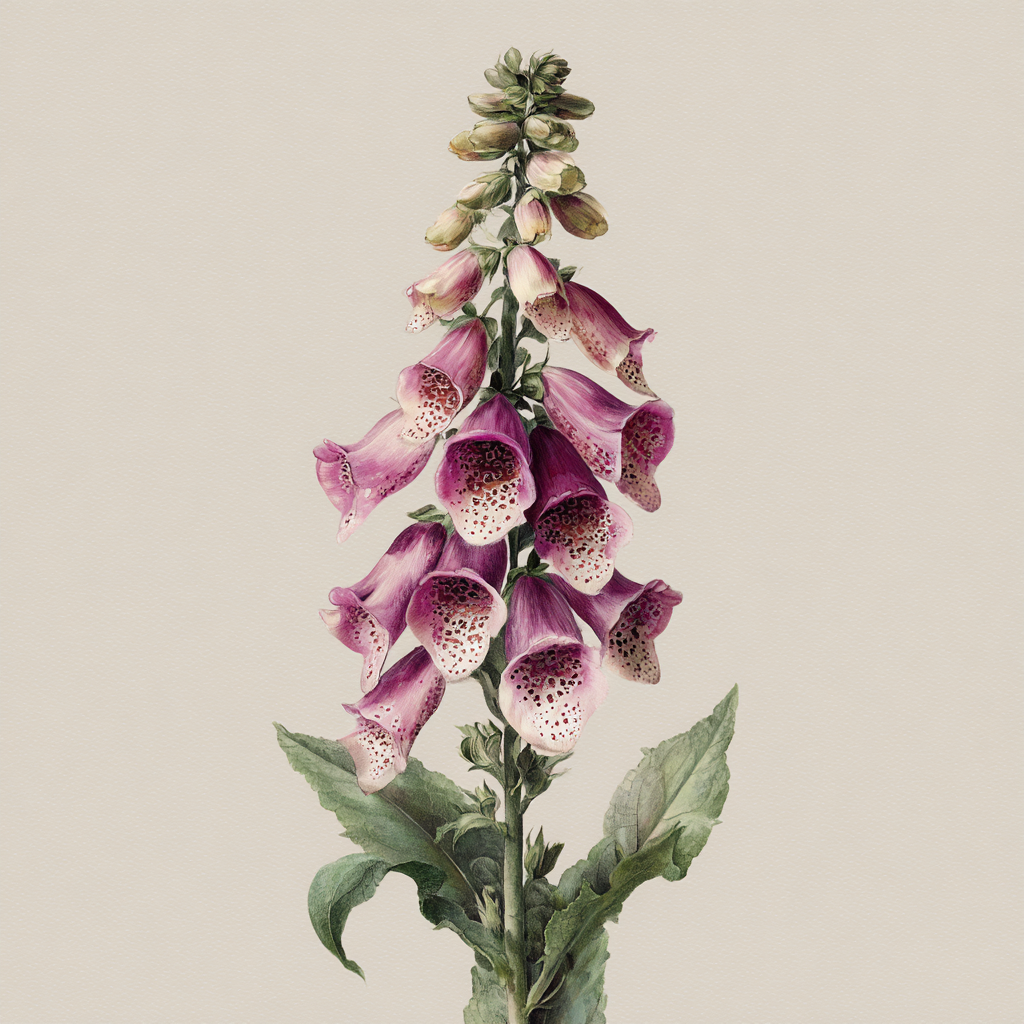
Have seeds for this? Add to inventory →Foxglove is a stately biennial producing tall, dramatic spikes of tubular flowers in shades of purple, pink, white, and cream, each spotted within to guide pollinators. Native to western Europe and naturalized across temperate regions worldwide, it thrives at woodland edges and in cottage gardens. Its bold vertical form makes it a prized cut flower and a magnet for bumblebees.
Growing Conditions
Growing Conditions
Sunlight
Full Sun to Partial Shade
Water Needs
Moderate
Soil
Moist, well-drained, humus-rich soil with slightly acidic to neutral pH; tolerates clay if drainage is adequate
Spacing
18 inches
Days to Maturity
Flowers in second year from seed; first-year rosettes establish in 60-90 days
Growing Zones
Growing Zones
Thrives in USDA Zones 4 - 9
When to Plant
When to Plant
Start Indoors
8-10 weeks before last frost for second-year bloom, or direct sow in late spring to early summer
Transplant
Transplant outdoors after last frost; seedlings overwinter as rosettes and bloom the following year
Direct Sow
Direct sow in late spring through midsummer; seeds need light to germinate
Harvest
Cut flower spikes when the lowest one-third to one-half of florets are open; for seed, allow spikes to dry on the plant until capsules turn tan
Phenology (Natural Timing Cues)
Start Indoors
Foxglove seed is tiny and light-dependent, so starting indoors gives better germination control than broadcasting outdoors in dry summer soils. Sow on the soil surface 8-10 weeks before last frost; if timing is off and seedlings go in too late, plants may not establish a robust enough rosette to survive winter and bloom the second year.
- Forsythia blooming or just past peak signals the start of the safe indoor-sow window
- Nights still regularly dropping below 40°F indicates seedlings should not yet go outdoors
- Dandelions actively blooming outdoors suggests transplant time is approaching for seedlings started indoors
Direct Sow
Direct sowing works well when soil is reliably moist in late spring or early summer; seeds require light and must not be buried. If sown too late in the season, rosettes will be too small to overwinter well in cold climates; if sown during hot, dry periods, germination is poor and erratic.
- Soil surface stays consistently moist after light rain, indicating favorable germination conditions
- Oak leaves approaching full size signals the late-spring direct-sow window is open
- Tender annual weeds germinating freely in bare soil patches signals soil temperature is adequate for foxglove seed
Start Dates (Your Location)
Average dates use your saved zone; readiness also checks your forecast when available.
Average Last Frost
Set your growing zone to see personalized calendar dates.
Use the average timing, but check your local forecast before planting.
Direct Sow
Spring
Use the seasonal timing note for this plant. Seeds need light to germinate.
Typical Harvest Window
May to July
Organic Growing Tips
Organic Growing Tips
Top-dress around rosettes in autumn with a 2-inch layer of leaf mold or compost to insulate roots and feed soil biology through winter
Water-in transplants with diluted worm casting tea to encourage rapid root establishment in the first weeks
Mulch between plants with straw or shredded bark to retain moisture and suppress weeds without smothering the crown
Avoid high-nitrogen feeds, which promote lush foliage at the expense of flower spike development; a balanced compost side-dressing in early spring is sufficient
Allow seed stalks to fully ripen and drop before cutting back to sustain a self-sowing colony without replanting every year
Care Guidance
Optional seasonal guidance for what you can do, even when nothing is urgent.
Care Guidance
Watering
If the top 2 inches of soil feel dry, a deep watering at the base may help more than frequent light watering. In healthy soil, rain may cover much of what it needs.
Feeding
If growth is strong, compost-rich soil often carries most of the load. If the plant starts looking pale or stalls, a light compost top-dressing or gentle organic feed may help.
Seasonal care
During the main season, harvesting when the crop is ready and removing damaged growth can help keep the planting productive if it starts to look crowded or tired.
Harvest timing
Harvests often cluster around May to July. If fruit, leaves, or roots start looking ready, color, size, firmness, and scent usually tell you more than the calendar alone.
Known Varieties
Common cultivars worth knowing
Known Varieties
Camelot Series
Compact F1 hybrid that blooms in the first year from an early indoor start, overcoming the typical biennial delay; strong upright spikes in cream, lavender, and white with heavy spotting.
Best for
Gardeners who want first-year flowers without waiting for a second season
Excelsior Group
An open-pollinated heritage strain with flowers arranged horizontally all around the spike rather than drooping to one side, giving a fuller, showier appearance; colors range from white to deep purple.
Best for
Cut flowers and traditional cottage garden displays
Pam's Choice
White flowers with deep burgundy-purple interior spotting on very tall spikes to 5 feet; one of the most striking bicolor forms available and reliably self-sows true.
Best for
Bold specimen planting and naturalized woodland edge colonies
Digitalis purpurea f. albiflora
Pure white-flowered botanical form with minimal spotting; elegant in shade gardens and pairs well with dark-foliaged plants.
Best for
White garden schemes and moonlight garden plantings
Companion Planting
Companion Planting
Common Pests
Common Pests
All pest management in Garden uses safe, organic, non-toxic methods only. No synthetic pesticides, ever.
Native Range
Native Range
- Origin
- Native to western and central Europe.
- Native Habitat
- Open woodlands, rocky hillsides, and disturbed areas in Europe.
- Current Distribution
- Naturalized widely across North America, Australia, and New Zealand; commonly cultivated.
Taxonomy
Taxonomy
- Kingdom
- Plantae
- Family
- Plantain family (Plantaginaceae)
- Genus
- Digitalis
- Species
- purpurea
Morphology
Morphology
Root System
Forms a taproot with fibrous secondary roots in the first year; the basal rosette stores energy for second-year flowering, so avoid disturbing roots after autumn establishment.
Stem
Second-year flower spikes grow 3-6 feet tall, stout and upright with a slight pubescence; cutting the main spike after bloom often stimulates smaller lateral spikes to extend the display.
Leaves
Large, heavily veined, softly hairy leaves with a wrinkled texture; yellowing or browning of lower leaves in summer heat is normal senescence, not disease, but dark spotting with yellow halos may indicate leaf spot fungus.
Flowers
Tubular bells are arranged spirally along the spike and open progressively from bottom to top; the interior spots act as nectar guides for long-tongued bumblebees, which are the primary pollinators.
Fruit
Seed capsules form after pollination, turning tan and papery when ripe; each capsule contains hundreds of tiny seeds that shed freely, making foxglove an aggressive self-sower if capsules are not removed before they split.
Natural History
Natural History
Digitalis purpurea is native to western Europe, from the Atlantic coast of Portugal and Spain through Britain and into central Europe, typically growing on woodland margins, rocky hillsides, and disturbed ground. The genus name derives from the Latin digitus, meaning finger, a reference to the tubular flowers. Welsh herbalist physicians of medieval Britain documented its use, and William Withering's 1785 monograph on the plant's cardiac properties marked a turning point in pharmacological history. In the garden, foxglove acts as a prolific self-sower, naturalizing into colonies that behave as perennials despite being true biennials.
Traditional Use
Traditional Use
Foxglove has one of the most consequential histories of any European medicinal plant, documented from at least the 13th century in Welsh herbal manuscripts. Its leaves were recorded in folk traditions across Britain and Western Europe primarily in the context of externally applied poultices and internally given preparations for edema and dropsy. William Withering's systematic 1785 account, 'An Account of the Foxglove,' formalized observations of its cardiac and diuretic effects and laid the groundwork for modern digitalis pharmacology.
Parts Noted Historically
Welsh folk medicine, 13th century - Leaves
Early Welsh herbal manuscripts, including those associated with the Physicians of Myddfai, recorded the leaves in formulations for skin conditions and swellings, representing some of the earliest documented European references to Digitalis.
English folk herbalism, 16th-18th century - Leaves
English herbalists including John Gerard and Nicholas Culpeper described the leaves as having cleansing and purging properties; country healers in the West Midlands of England used leaf preparations for dropsy, a practice that William Withering investigated systematically after learning of it from a local woman's folk recipe in 1775.
William Withering, 'An Account of the Foxglove,' 1785 - Leaves
Withering's monograph documented 163 cases and described the dried powdered leaf's observable effects on heart rate and fluid retention, effectively translating longstanding folk observation into systematic botanical medicine and establishing the foundation for the cardiac glycoside drugs derived from foxglove in modern medicine.
All parts of Digitalis purpurea are highly toxic; the leaves, seeds, and flowers contain cardiac glycosides including digitoxin that are poisonous to humans, dogs, cats, and livestock if ingested, and can cause serious cardiac effects even in small quantities. Contact with the plant may cause skin irritation in sensitive individuals.
This information is provided for historical and educational purposes only and is not medical advice. Always consult a qualified healthcare professional before making decisions related to your health.
Loading photo submission…