Ginger
HerbZingiber officinale
Have seeds for this? Add to inventory →Ginger is a tropical rhizome grown for its pungent, aromatic root that is indispensable in Asian, South Asian, and Caribbean cuisines. In warm climates it is a long-lived perennial; in cold climates it thrives in containers that can be brought inside. One of the most rewarding herbs to grow for cooks.
Growing Conditions
Growing Conditions
Sunlight
Partial Shade
Water Needs
Moderate
Soil
Rich, loose, well-draining soil; pH 5.5 - 6.5; high organic matter
Spacing
8 - 12 inches
Days to Maturity
8 - 10 months from rhizome planting for mature root; young ginger harvestable from 4 months
Growing Zones
Growing Zones
Thrives in USDA Zones 8 - 12
When to Plant
When to Plant
Direct Sow
Plant rhizome sections indoors 8 - 12 weeks before last frost; transplant after soil warms to 65°F; in zones 8+, plant directly after last frost
Harvest
8 - 10 months; dig in autumn when leaves yellow; baby ginger can be harvested from 4 months
Phenology (Natural Timing Cues)
Start Indoors
In zones below 8, ginger must be started indoors in late winter in containers. Soak rhizome sections overnight, then plant with buds facing up just below the surface in moist potting mix. Keep at 70°F+ and maintain moisture. Move outside after last frost to a warm, sheltered spot with morning sun and afternoon shade. Bring containers back inside before first frost in autumn. In zones 8 and above, plant directly in the ground after last frost when soil has warmed.
- Indoors: start 8 - 12 weeks before the last frost date.
- Eye buds visible on rhizome sections indicate readiness to plant.
- Outdoor transplant: night temperatures stay above 55°F.
- Soil at planting depth has warmed to 65°F+.
Start Dates (Your Location)
Average dates use your saved zone; readiness also checks your forecast when available.
Use the average timing, but check your local forecast before planting.
Organic Growing Tips
Organic Growing Tips
Mulch heavily around plants to maintain moisture and replicate tropical forest-floor conditions.
Feed with a balanced liquid fertilizer every 2 - 3 weeks through the growing season.
Harvest baby ginger from 4 months for a milder, more tender product; or wait until foliage yellows in autumn for full-size pungent roots.
Save the plumpest, most vigorous rhizome sections with the most eye buds for replanting the following season.
Care Guidance
Optional seasonal guidance for what you can do, even when nothing is urgent.
Care Guidance
Watering
If the top 2 inches of soil feel dry, a deep watering at the base may help more than frequent light watering. In healthy soil, rain may cover much of what it needs.
Feeding
Extra feeding is rarely required if soil is healthy. If growth looks pale or slow, a light compost top-dressing is often enough before adding anything stronger.
Seasonal care
During the main season, harvesting when the crop is ready and removing damaged growth can help keep the planting productive if it starts to look crowded or tired.
Known Varieties
Common cultivars worth knowing
Known Varieties
Common Ginger
The standard culinary ginger sold worldwide; strong pungency with fibrous texture at full maturity; the base reference for all ginger products.
Best for
culinary use, drying, candying, full flavor
Baby Ginger
Harvested at 4 - 6 months before the skin hardens; tender, mild, pink-tinged, with no need to peel; exceptional for pickling and fresh use.
Best for
fresh eating, pickling, mild flavor
Hawaiian Yellow
Large, thick rhizomes with a lemony, mild flavor profile; widely grown in Hawaii and popular for fresh culinary use.
Best for
mild flavor, fresh use, container growing
Companion Planting
Companion Planting
Good companions
Avoid planting near
No known conflicts
Common Pests
Common Pests
- Root Rot
- Rhizome Rot
- Red Spider Mite
- Fungus Gnats
All pest management in Garden uses safe, organic, non-toxic methods only. No synthetic pesticides, ever.
Simple Ways to Use
Simple Ways to Use
Start here if you're not sure how to use this crop in the kitchen.
Quick recipes you can make right away
Fresh Grated Ginger
Peel the ginger if the skin is tough, then grate or mince it finely and add it to stir-fries, soups, or dressings near the start of cooking. Use less than you think at first, because fresh ginger builds quickly in a dish.
Ginger Tea
Slice fresh ginger thinly, simmer it in water for 10 to 15 minutes until the liquid smells spicy and warm, then strain before drinking. Add honey or lemon only after tasting, because fresh ginger can be stronger than expected.
Ginger Rice or Broth Base
Saute chopped ginger in a little oil for 30 to 60 seconds until fragrant, then add rice, broth, or vegetables right away. Keep the heat moderate so the ginger softens without scorching.
How to Preserve
How to Preserve
Use this section to store or process extra harvest before it spoils.
Practical methods for extra harvest
Freeze ginger pieces
Cut the rhizome into chunks or leave it whole, then freeze it in a bag or airtight container so you can grate or slice it straight from frozen. Frozen ginger softens a little but still works very well in cooked dishes and tea.
Dry sliced ginger
Slice peeled ginger thinly and dry it at 125°F to 135°F until the pieces are fully hard and brittle with no leathery center left, usually several hours to a day depending on thickness. Cool the slices fully before storing so the jar stays dry.
Grind dried ginger
Dry the slices completely, then grind them only when they snap cleanly instead of bending. Let the powder settle before opening the grinder so the dust does not puff into the air.
New to preserving food?
New to freezing? Read the freezing guide.New to dehydrating? Read the dehydrating guide.How to Store
How to Store
Simple storage tips
Keep fresh ginger in the refrigerator in a bag or covered container, where it often keeps for 2 to 3 weeks.
If you will not use it soon, freeze it promptly, because frozen ginger is easy to grate as needed.
Store dried ginger slices or powder in an airtight jar away from heat and light, and expect the best flavor within about 6 to 12 months.
Use rhizomes with firm flesh and healthy skin first, and trim away any soft or moldy spots before using.
Do not seal damp ginger pieces for storage, because trapped moisture leads to mold quickly.
How to Save Seed
How to Save Seed
Step-by-step seed saving
- 1
Ginger does not normally set useful seed in cultivation, and most growers replant part of the rhizome rather than saving seed.
- 2
Choose plump healthy rhizome sections with visible buds from your best harvest and keep them for replanting.
- 3
Store the saved rhizomes in a cool dry place or lightly moist medium where they stay firm but do not rot.
- 4
Use this rhizome-saving method if you want to keep the same ginger line going from year to year.
Native Range
Native Range
- Origin
- Cultivated in South and Southeast Asia for over 3,000 years; likely originated in the Maritime Southeast Asian region or New Guinea.
- Native Habitat
- No truly wild population known; wild relatives grow in tropical forest understory in Southeast Asia.
- Current Distribution
- Cultivated in tropical and subtropical regions worldwide; India is the largest producer, followed by China, Nigeria, and Indonesia.
Taxonomy
Taxonomy
- Kingdom
- Plantae
- Family
- Ginger family (Zingiberaceae)
- Genus
- Zingiber
- Species
- officinale
Morphology
Morphology
Root System
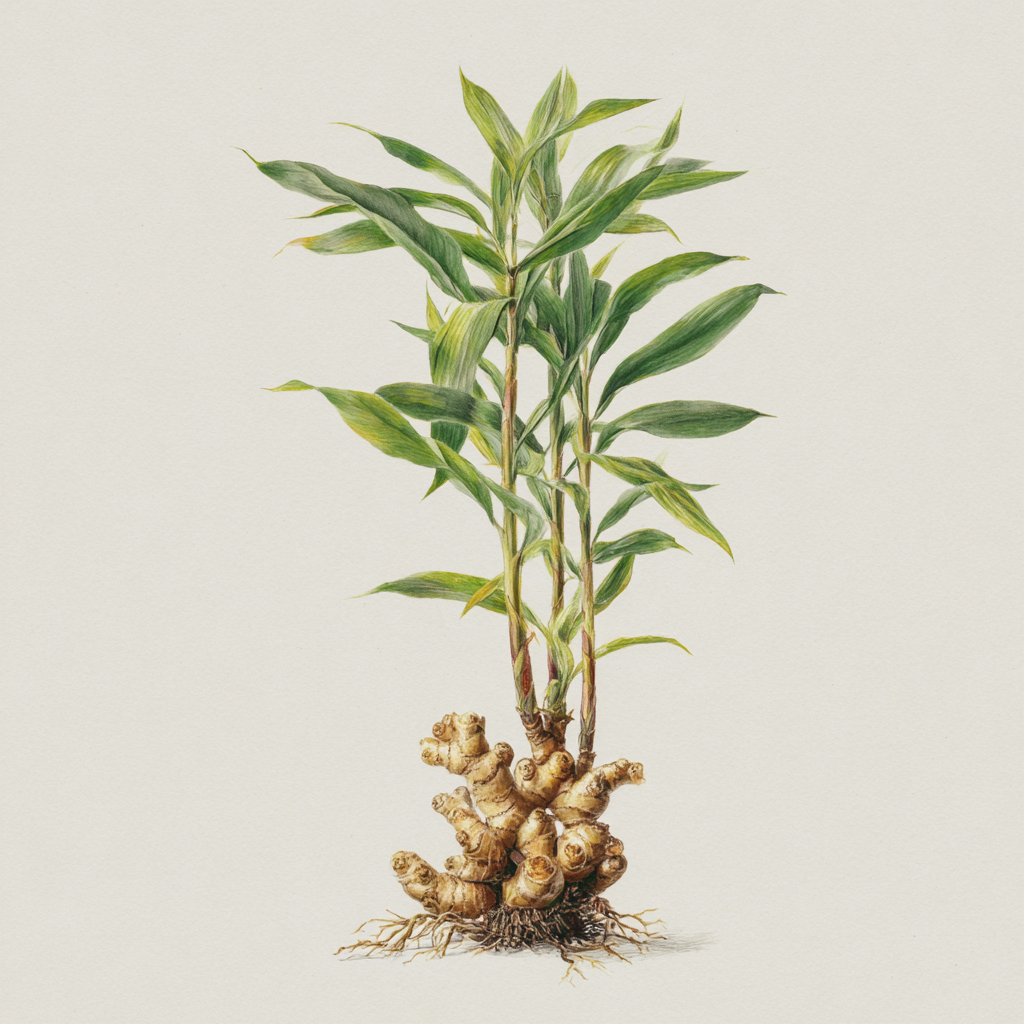
Spreading, fleshy, irregular rhizome system just below the soil surface; the harvestable root consists of the primary rhizome and its branching lateral sections.
Stem
Upright, reed-like pseudostems formed by tightly rolled leaf sheaths; 2 - 4 feet tall; green; not woody.
Leaves
Narrow, lance-shaped, alternate, aromatic; bright green; emerge from the base in a two-ranked arrangement.
Flowers
Rarely flowers outside tropical conditions; when it does, produces exotic green and yellow blooms on short spikes from the rhizome base.
Fruit
Rarely produces seed in cultivation; propagated entirely vegetatively from rhizome sections.
Natural History
Natural History
Zingiber officinale has been cultivated for so long that it no longer reproduces from seed and exists only in cultivation - no truly wild population has been definitively identified, though genetic evidence points to an origin in tropical Southeast Asia, most likely the island of New Guinea or the surrounding Maritime Southeast Asian region. The plant has been central to Indian Ayurvedic medicine for at least 3,000 years and features in the oldest Chinese pharmacopeias. Arab traders introduced ginger to the Mediterranean world, and it was among the most expensive spices in medieval Europe - priced comparably to black pepper, which itself was worth more than silver by weight at peak demand. The Roman Empire imported ginger in substantial quantities from India and Arabia, and ginger appears in Roman cookbooks of the 1st century CE. When the Portuguese opened direct sea routes to India and the Spanish introduced ginger to the Caribbean and New World tropics, European prices collapsed and ginger became widely accessible for the first time.
Traditional Use
Traditional Use
Ginger has one of the most thoroughly cross-cultural medicinal histories of any plant, documented across Ayurvedic, Traditional Chinese Medicine, Arab Unani, and European herbal traditions spanning more than 2,500 years. Its primary documented applications revolve around digestive and nausea-related conditions, which modern clinical research has substantially supported, particularly for morning sickness and chemotherapy-induced nausea.
Parts Noted Historically
Ayurvedic medicine, India (1,000 BCE onward) - Rhizome
Zingiber officinale (Sanskrit: shunthi for dried, ardrak for fresh) is one of the most frequently referenced plants in the Charaka Samhita and Sushruta Samhita. It was classified as a digestive, carminative, and stimulant, and used in compound formulations for nausea, colic, and respiratory conditions, including as a component of trikatu, the classic three-spice combination with black pepper and long pepper.
Traditional Chinese Medicine - Rhizome (fresh and dried)
Fresh ginger (sheng jiang) and dried ginger (gan jiang) are treated as distinct medicines with different therapeutic properties in Chinese herbal tradition. Fresh ginger is classified as warming and used for cold-pattern nausea and respiratory conditions; dried ginger is considered more potently warming and used for chronic cold-deficiency patterns. Ginger is one of the most frequently prescribed herbs in classical Chinese formulas.
European herbal tradition, medieval period - Root
Ginger was included in the materia medica of virtually every European herbal from Dioscorides through Gerard and Culpeper. It was prescribed for digestive complaints and cold-natured conditions in an era when Galenic humoralism considered the thermal quality of foods and medicines central to treatment. Gingerbread and ginger-spiced wines (hippocras) served dual purposes as foods and digestive medicines.
Ginger is generally regarded as safe in culinary quantities for most adults. High doses (more than 5 grams daily) may cause heartburn, gas, or digestive discomfort. Ginger affects platelet aggregation and may interact with blood-thinning medications (warfarin, aspirin). It is considered safe in culinary amounts during pregnancy and commonly used for morning sickness, but medicinal doses should be discussed with a healthcare provider. People with gallstones should consult a physician before using ginger therapeutically.
This information is provided for historical and educational purposes only and is not medical advice. Always consult a qualified healthcare professional before making decisions related to your health.
Loading photo submission…