Goji Berry
FruitLycium barbarum
Have seeds for this? Add to inventory →Goji berry is an extraordinarily cold-hardy and heat-tolerant deciduous shrub producing nutritionally dense red berries prized in Chinese medicine for over 2,000 years. It is one of the easiest fruiting shrubs to establish, tolerating drought, poor soil, and extreme cold once rooted. Fresh berries have a mildly sweet, slightly bitter flavour; dried berries develop a concentrated sweetness similar to dried cranberry crossed with tomato.
Growing Conditions
Growing Conditions
Sunlight
Full Sun
Water Needs
Low
Soil
Well-draining loam, sandy loam, or even poor soils; tolerates alkaline conditions; pH 6.0 - 8.5; does not tolerate waterlogged roots
Spacing
4 - 6 feet
Days to Maturity
First berries in year 2-3; full production by year 4-5
Growing Zones
Growing Zones
Thrives in USDA Zones 3 - 9
When to Plant
When to Plant
Transplant
Plant container-grown shrubs in spring or autumn; goji establishes readily and tolerates a range of planting times
Harvest
Gently shake or hand-pick berries when fully red and slightly soft; mature berries detach easily. Avoid touching eyes after handling - goji berries stain fingers deeply. Harvest every few days during peak season
Phenology (Natural Timing Cues)
Transplant
Goji berry is forgiving to plant and adapts readily across a wide range of conditions. Spring planting after frost risk has passed is most reliable; autumn planting also works well in zones 5 and warmer. Goji spreads by root suckers and will need containment in small gardens.
- Frost risk has largely passed and soil has begun to warm.
- Soil is workable and draining well.
Start Dates (Your Location)
Average dates use your saved zone; readiness also checks your forecast when available.
Best Planting Window
Spring window
Spring
Plant early enough for roots to settle before summer heat.
Autumn window
Early autumn
Plant early enough for roots to grow before winter; avoid late planting into cold, wet soil.
Planting Method
Plant nursery-grown goji berry stock or rooted cuttings. Seed-grown plants are slow, variable, and usually not the best way to establish a productive planting.
Critical Timing Note
Plant early enough for roots to establish before weather stress arrives.
Use the average timing, but check your local forecast before planting.
Typical Harvest Window
July to October
Organic Growing Tips
Organic Growing Tips
Prune hard each spring to encourage vigorous new growth, which produces the best fruit; remove 1/3 of old canes and cut back all laterals to 2-3 nodes.
Apply a balanced organic fertiliser in early spring; avoid excessive nitrogen which promotes lush foliage at the expense of berries.
Control aphid pressure with strong water sprays or insecticidal soap; goji aphids are rarely severe enough to require treatment beyond mechanical removal.
Install root barriers or mow regularly around the perimeter to prevent invasive suckering into nearby beds.
Care Guidance
Optional seasonal guidance for what you can do, even when nothing is urgent.
Care Guidance
Watering
Extra watering is often only useful during extended dry periods. If the top 2 to 3 inches are still holding moisture, additional water may not help.
Feeding
Extra feeding is rarely required if soil is healthy. If growth looks pale or slow, a light compost top-dressing is often enough before adding anything stronger.
Pruning
If pruning is needed, dormancy or the period just after harvest is often the simplest window. Dead, damaged, or crossing growth is usually the first place to start.
Seasonal care
In late fall, a light cleanup and fresh mulch can help if winter protection is useful in your climate. Leaving a little space around crowns and trunks often helps air move and keeps excess moisture from sitting there.
Known Varieties
Common cultivars worth knowing
Known Varieties
Ningxia
The standard commercial cultivar from the famous Ningxia production region; reliable, productive, large berries with excellent flavour.
Best for
General production; the closest to authentic Chinese goji
Sweet Lifeberry
European-developed cultivar with notably sweeter fresh berries than standard types; bred for fresh eating rather than drying.
Best for
Fresh eating; lower bitterness
Big Lifeberry
Large-berried cultivar developed for improved harvest efficiency; vigorous, productive, and widely available in North America.
Best for
Home gardens; easier harvesting
Companion Planting
Companion Planting
Good companions
None noted
Support & insectary plants
Nearby plants that attract pollinators, beneficial insects, or improve soil health.
- Lavender
Attracts pollinators and beneficial insects
- Yarrow
Attracts beneficial insects and produces nutrient-rich mulch
- Comfrey
Attracts beneficial insects and produces nutrient-rich mulch
- Borage
Attracts beneficial insects and produces nutrient-rich mulch
- Marigold
Suppresses soil nematodes; trap crop for aphids and whiteflies
Avoid planting near
No known conflicts
Common Pests
Common Pests
All pest management in Garden uses safe, organic, non-toxic methods only. No synthetic pesticides, ever.
Simple Ways to Use
Simple Ways to Use
Start here if you're not sure how to use this crop in the kitchen.
Quick recipes you can make right away
Fresh Goji Berry Bowl
Rinse ripe berries gently and use them fresh once they are fully colored and slightly soft, because underripe berries taste less developed. Eat them promptly, because they bruise easily after harvest.
Goji Berry Syrup
Simmer goji berries with a little water and sugar for 10 to 15 minutes until the berries soften and the liquid takes on a deep color. Strain if you want a smoother syrup for yogurt, drinks, or desserts.
Goji Berry Compote
Cook the berries with a small splash of water for 5 to 8 minutes until they soften and the juice thickens slightly. Stop while some berries still hold shape if you want a spoonable compote instead of jam.
How to Preserve
How to Preserve
Use this section to store or process extra harvest before it spoils.
Practical methods for extra harvest
Dry goji berries
Spread ripe berries in a single layer and dry them at 125°F to 135°F until they feel leathery with no wet juice left inside when squeezed gently, usually several hours to a day depending on size. Cool them fully before jarring so the container stays dry.
Freeze goji berries on a tray
Spread clean dry berries in a single layer and freeze them until hard before bagging so they stay loose instead of crushing together. Use them later in smoothies, compote, or baking.
Make goji jam or syrup
Cook the berries with sugar until they soften and the liquid thickens enough for your intended use, or follow a tested preserving recipe if you want shelf-stable jars. Refrigerate or freeze small batches unless you are using a tested canning method.
How to Store
How to Store
Simple storage tips
Keep fresh goji berries cold in the refrigerator and use them within about 2 to 4 days, because they are delicate once picked.
Store them dry in a shallow container so the berries underneath do not crush.
Do not wash them before storage, because extra surface moisture speeds spoilage.
Store dried goji berries in an airtight jar away from heat and light, and expect the best quality within about 6 to 12 months.
Use bruised or leaking berries first for syrup, compote, or freezing.
How to Save Seed
How to Save Seed
Step-by-step seed saving
- 1
Goji can be grown from seed, but named plants are usually propagated from cuttings or nursery stock if you want fruit quality and plant habit to stay consistent.
- 2
If you save seed, crush fully ripe berries, rinse away the pulp, and keep the clean seeds that remain.
- 3
Dry the seeds briefly until surface moisture is gone, then store them in a cool dry place if you want to experiment.
- 4
Use cuttings or nursery plants instead of seed if you want to keep a named goji type true to form.
Native Range
Native Range
- Origin
- Native to temperate and dry-temperate zones of central and northwestern China, Mongolia, and Central Asia; the Ningxia region of northwest China is the center of cultivation.
- Native Habitat
- Dry mountain slopes, loess plateaus, river banks, and grassland margins in semi-arid continental climates.
- Current Distribution
- Cultivated worldwide; naturalized as an invasive plant in parts of western North America, southern Europe, and Australia. Commercial production centered in Ningxia, China.
Taxonomy
Taxonomy
- Kingdom
- Plantae
- Family
- Nightshade family (Solanaceae)
- Genus
- Lycium
- Species
- Lycium barbarum
Morphology
Morphology
Root System
Extensive, deep, spreading root system with a strong tendency to sucker; the aggressive root suckering that makes it invasive in some contexts is also what makes it drought-tolerant and cold-hardy once established.
Stem
Sprawling to arching deciduous shrub typically 3-6 feet tall and spreading wider; stems are slightly ribbed and develop small spines at nodes. Trained on a trellis or pruned annually, plants are much more compact and productive.
Leaves
Small, elliptical to lance-shaped grey-green leaves 1-3 inches long; leaves emerge early in spring and are among the first foliage to appear after cold winters.
Flowers
Small, tubular, lavender to purple five-petaled flowers in the leaf axils; self-fertile, flowering over a very long period from summer through autumn and attracting bees consistently.
Fruit
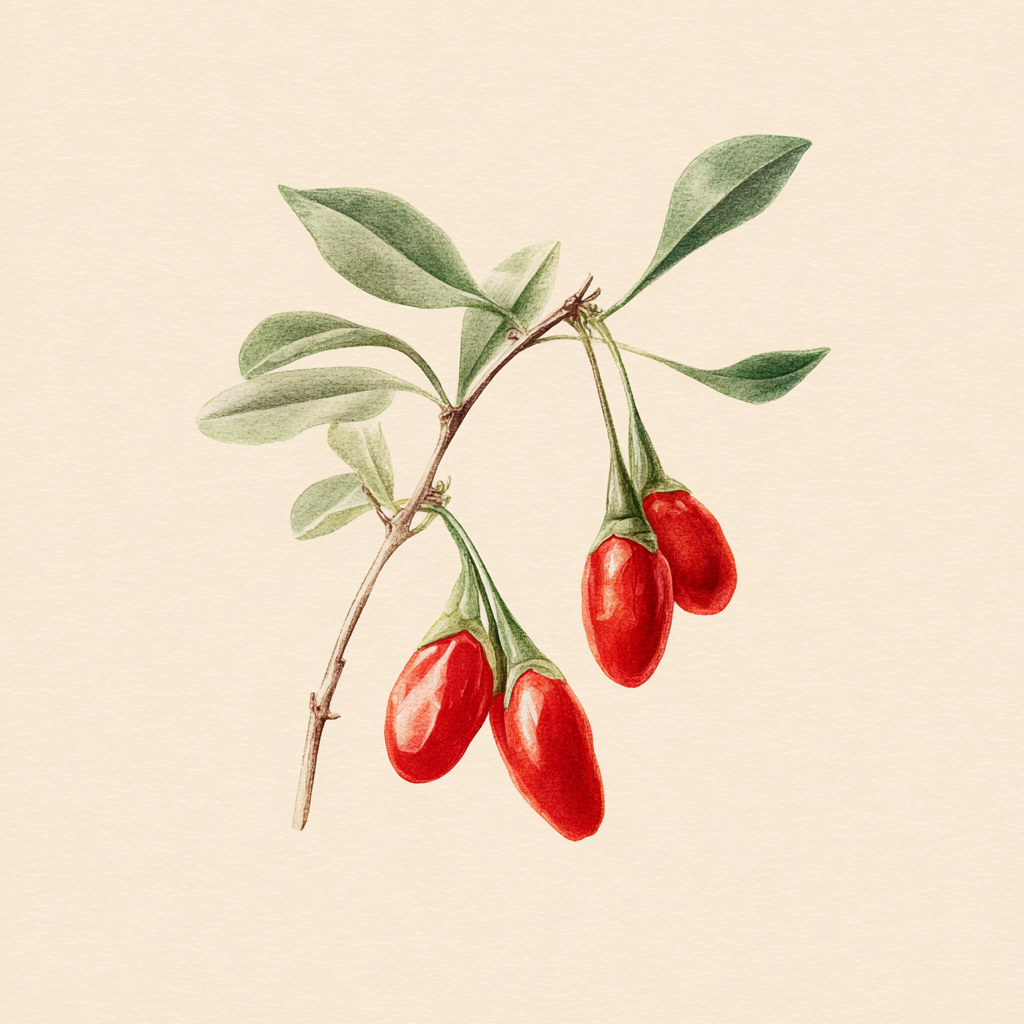
Oval, bright red berries 0.5-1 inch long, resembling small elongated tomatoes; fresh berries are mildly sweet with a slight bitterness. Dried berries become sweeter and more concentrated, with a texture similar to a small raisin.
Natural History
Natural History
Goji berry (Lycium barbarum) is native to the temperate grasslands, dry valleys, and mountain slopes of central and northwestern China, with a broader natural range extending through Central Asia. It has been cultivated in China for over 2,000 years, primarily in the Ningxia Hui Autonomous Region and Xinjiang, where the best commercial berries are still grown today. Ningxia goji berries have Protected Geographical Indication status in China comparable to Champagne in France. In Chinese culture, goji berry became associated with longevity and eye health in classical medical texts, and stories circulated in the West about communities in Ningxia with exceptional lifespans attributed to daily goji consumption - stories that were largely embellished by Western marketing campaigns of the early 2000s. The "superfood" marketing boom beginning around 2004 transformed goji from an obscure traditional ingredient into a global commodity. Lycium barbarum naturalized in parts of southern Europe, western North America, and Australia after introduction and is now classified as invasive in some regions.
Traditional Use
Traditional Use
Goji berry (called gouqi or wolfberry in Chinese) has one of the longest continuous records of use in any traditional medical system, appearing in Chinese pharmacopeias for over 2,000 years. The primary documented applications involve eye health, liver and kidney function, and longevity traditions.
Parts Noted Historically
Traditional Chinese Medicine (Shen Nong Ben Cao Jing and later pharmacopeias) - Berries and root bark
Goji berries (gouqi) appear in the Shen Nong Ben Cao Jing, the foundational Chinese herbal text attributed to the legendary Emperor Shennong and compiled around 100-200 AD. The text classifies the berries as a superior-grade tonic that "nourishes the liver and kidney, brightens the eyes, and strengthens the tendons and bones." The root bark (digupi) was separately valued in Chinese medicine for reducing fever associated with deficiency conditions. These applications persisted essentially unchanged through 2,000 years of Chinese medical tradition.
Ningxia Hui traditional food use - Fresh and dried berries
In the Ningxia region of northwest China, goji berries have been cultivated as both a food crop and medicinal tonic for over 600 years; regional records from the Ming dynasty (1368-1644) describe systematic cultivation practices. The berries were added to soups, porridges, and teas as a daily tonic food rather than a concentrated medicine - a use that blurred the line between food and pharmacy in a way characteristic of Chinese nutritional medicine.
Goji berries are safe as a food in normal culinary amounts and have a long history of consumption. However, goji berry significantly enhances the anticoagulant effect of warfarin (blood thinners) and may interact with blood pressure and diabetes medications. Do not consume in large therapeutic quantities without consulting a healthcare provider if taking medications. Goji belongs to the nightshade family; people with nightshade sensitivity may react.
This information is provided for historical and educational purposes only and is not medical advice. Always consult a qualified healthcare professional before making decisions related to your health.
Loading photo submission…