Plum
FruitPrunus domestica
Have seeds for this? Add to inventory →Plum is a deciduous fruit tree prized for its sweet, juicy stone fruit ranging from deep purple to red, yellow, and green depending on variety. Trees bear fragrant white flowers in early spring before leaves emerge, making them ornamentally appealing while also drawing pollinators. With proper variety selection and a little patience through establishment, plums are one of the most rewarding orchard trees for home growers in temperate climates.
Growing Conditions
Growing Conditions
Sunlight
Full Sun
Water Needs
Moderate
Soil
Deep, well-draining, fertile loam; pH 5.5–6.5
Spacing
15–20 feet (standard); 8–10 feet (semi-dwarf)
Days to Maturity
3–5 years to first significant harvest depending on rootstock
Growing Zones
Growing Zones
Thrives in USDA Zones 4 - 9
When to Plant
When to Plant
Transplant
Plant bare-root or container trees in early spring before bud break, or in autumn after leaf drop
Harvest
Fruit is picked when it yields to gentle pressure and has developed full color
Phenology (Natural Timing Cues)
Transplant
Plum trees are planted as bare-root or container nursery stock, not started from seed. Bare-root trees must go in the ground while fully dormant, before buds swell, so roots establish in cool moist soil before the energy demand of leafing out. Planting too late - after buds break - forces the tree to leaf out before roots are anchored, stressing the tree and reducing first-year growth. Container trees have a longer window but still benefit from early-season planting. Autumn planting after leaf drop is an equally strong option in zones 6–9 where winters are not severe.
- Forsythia blooming or just finishing marks the outer edge of the safe bare-root window
- Plum buds swollen but not yet showing green tissue - ideal planting moment for bare-root
- Soil workable and draining cleanly after winter saturation
- Overnight temperatures staying reliably above 28°F in autumn for fall planting
Start Dates (Your Location)
Average dates use your saved zone; readiness also checks your forecast when available.
Best Planting Window
Spring window
Early spring
Plant as soon as the soil is workable so roots establish before heat arrives.
Autumn window
Usually skip autumn planting
Use spring unless you have locally grown nursery stock and enough mild weather for roots to establish.
Planting Method
Plant a grafted bare-root nursery tree. Seed-grown fruit trees are not true-to-type, so nursery stock is the reliable path to known fruit quality.
Critical Timing Note
Plant while dormant and before bud break so roots establish before leaves demand water.
Use the average timing, but check your local forecast before planting.
Typical Harvest Window
July to September
Organic Growing Tips
Organic Growing Tips
Use kaolin clay spray to deter plum curculio during petal fall and early fruit development.
Thin fruit clusters to improve air circulation and reduce brown rot pressure.
Plant a guild of comfrey, chives, and lavender beneath the tree for beneficial insects.
Care Guidance
Optional seasonal guidance for what you can do, even when nothing is urgent.
Care Guidance
Watering
If the top 2 inches of soil feel dry, a deep watering at the base may help more than frequent light watering. In healthy soil, rain may cover much of what it needs.
Feeding
Extra feeding is rarely required if soil is healthy. If growth looks pale or slow, a light compost top-dressing is often enough before adding anything stronger.
Pruning
If pruning is needed, dormancy or the period just after harvest is often the simplest window. Dead, damaged, or crossing growth is usually the first place to start.
Seasonal care
In late fall, a light cleanup and fresh mulch can help if winter protection is useful in your climate. Leaving a little space around crowns and trunks often helps air move and keeps excess moisture from sitting there.
Pollination & Fruit Production
Pollination & Fruit Production
The pollination helper includes compatibility guidance for plum.
Need a compatible partner? Open the Fruit Tree Planner.Known Varieties
Common cultivars worth knowing
Known Varieties
- Stanley
A classic European freestone prune plum with deep blue-purple skin and amber-yellow flesh; reliably productive, self-fertile, and excellent for fresh eating, drying, and preserves. One of the most widely planted backyard plums in the northeastern United States.
Best for
Drying, preserves, fresh eating; zones 5–8
- Italian Prune (Fellenberg)
An heirloom European plum widely grown in the Pacific Northwest and Mediterranean climates; oval blue-purple fruit with dense sweet flesh that dries without pitting. Self-fertile and a reliable heavy producer.
Best for
Drying whole as prunes; zones 5–9
- Methley
A Japanese-type plum with red-purple skin and juicy, mild red flesh; one of the few Japanese plums that is self-fertile. Ripens early (June–July in warm zones) and tolerates lower chilling hours, making it well suited to zones 7–9.
Best for
Fresh eating in warm climates; low-chill zones 7–9
- Shiro
A Japanese plum with yellow skin and pale sweet flesh; mild flavor and attractive appearance make it popular for fresh market and home eating. Requires a pollinator such as Methley or Santa Rosa.
Best for
Fresh eating and markets; zones 5–9
- Damson
A small, tart blue-purple European plum with intensely flavored flesh; too astringent for most fresh eating but exceptional for jam, jelly, and gin. Highly disease-resistant and productive even on poorer soils.
Best for
Preserves, jams, and liqueurs; zones 5–7
Companion Planting
Companion Planting
Good companions
Support & insectary plants
Nearby plants that attract pollinators, beneficial insects, or improve soil health.
- Comfrey
Attracts beneficial insects and produces nutrient-rich mulch
- Lavender
Attracts pollinators and beneficial insects
- Marigold
Suppresses soil nematodes; trap crop for aphids and whiteflies
- Nasturtium
Trap crop for aphids; attracts beneficial insects
Avoid planting near
No known conflicts
Common Pests
Common Pests
- Plum Curculio
- Brown Rot
- Aphids
- Black Knot
- Peach Borer
All pest management in Garden uses safe, organic, non-toxic methods only. No synthetic pesticides, ever.
Simple Ways to Use
Simple Ways to Use
Start here if you're not sure how to use this crop in the kitchen.
Quick recipes you can make right away
Fresh Plum Skillet Compote
Slice plums off the pits, cook them in a skillet with a little sugar for 5 to 8 minutes, and stir until the fruit softens and the juice thickens slightly. Stop while some pieces still hold their shape if you want spoonable compote instead of jam.
Roasted Plum Halves
Halve and pit the plums, place them cut side up, and roast at 375°F for 20 to 30 minutes until the flesh softens and the juices bubble around the centers. Cool them a few minutes before serving so the fruit firms slightly instead of falling apart on the plate.
Baked Plum Crisp
Slice plums into a baking dish, add sugar if they taste tart, and bake at 375°F until the juices bubble hard at the edges and the fruit is tender when pierced, about 30 to 40 minutes. Let the dish rest 10 minutes so the juices thicken slightly before scooping.
How to Preserve
How to Preserve
Use this section to store or process extra harvest before it spoils.
Practical methods for extra harvest
Freeze plum halves
Halve and pit ripe plums, freeze them cut side up on a tray until hard, then bag them so they stay separate instead of clumping. Use them frozen for baking, sauce, or smoothies, because thawed plums soften more than fresh fruit.
Make plum jam or preserves
Cook chopped plums with sugar until the fruit breaks down and the mixture thickens enough to mound lightly on a spoon, or follow a tested jam recipe if you want shelf-stable jars. Water-bath can it only with a tested recipe and the full processing time for your jars and altitude.
Dry plum halves
Halve and pit plums, place them cut side up, and dry them at 135°F until they feel leathery and no wet juice appears when squeezed at the cut face. Cool them fully before jarring, and refrigerate them if they still feel sticky or damp after cooling.
How to Store
How to Store
Simple storage tips
Ripen firm plums at room temperature until they smell fruity and give slightly when pressed near the stem end.
Move fully ripe plums to the refrigerator if you need a few extra days, but use them before the skin wrinkles and the flesh turns mushy.
Keep ripe plums in a shallow bowl or container so the fruit underneath does not bruise under the weight of the rest.
Use split, bruised, or leaking plums first for cooking or preserving, because damaged fruit spoils quickly.
Check ripening fruit daily, because plums can move from firm to overripe in a short time once they start softening.
How to Save Seed
How to Save Seed
Step-by-step seed saving
- 1
Plum pits do not grow true to the named variety, so saving pits is not the practical way to keep a plum like Methley or Stanley the same.
- 2
If you want more of the same plum, use grafting or buy a grafted tree rather than saving pits for planting.
- 3
Pits can be planted only for breeding or experimentation, not for keeping a named plum true to type.
Native Range
Native Range
- Origin
- Prunus domestica is believed to have originated as a natural or early-cultivated hybrid in the region spanning the Caucasus and the Caspian lowlands, where its likely parent species - cherry plum (Prunus cerasifera) and blackthorn (Prunus spinosa) - overlap in the wild.
- Native Habitat
- The ancestral habitat of its parent species ranges from forest margins, scrubby hillsides, and riparian edges in western Asia and the Caucasus to hedgerows and woodland borders across Europe.
- Current Distribution
- Cultivated throughout temperate regions worldwide, with the greatest production in Europe, China, and North America. The species does not naturalize aggressively but escapes cultivation occasionally along roadsides and field margins in Europe and North America.
Taxonomy
Taxonomy
- Kingdom
- Plantae
- Family
- Rose family (Rosaceae)
- Genus
- Prunus
- Species
- Prunus domestica
Morphology
Morphology
Root System
Plum trees develop a moderately spreading root system that extends roughly to the drip line and slightly beyond; standard trees on seedling rootstocks produce deep anchoring roots, while semi-dwarf and dwarfing rootstocks produce shallower, more fibrous systems that require consistent moisture and benefit from permanent mulching. Graft union integrity is critical - keep soil and mulch clear of the union to prevent rootstock suckering and crown rot.
Stem
Trees grow with a central leader or open-vase framework depending on training; unpruned trees become dense and tangled, reducing light penetration and increasing brown rot pressure. Productive fruiting spurs form on two- and three-year-old wood; annual light pruning to remove crossing, dead, or inward-facing branches maintains the fruiting zone and airflow. Black knot fungal galls on stems and branches should be pruned out with 4–6 inches of healthy wood and removed from the site immediately.
Leaves
Leaves are oval to oblong with finely serrated margins and a slightly glossy upper surface; yellowing leaves in midsummer can signal drought stress, waterlogging, or nitrogen deficiency, while premature defoliation often indicates brown rot or bacterial canker. Leaf curl with sticky residue points to aphid colonies on new growth.
Flowers
White five-petaled flowers appear in early to mid-spring, typically before or with first leaf emergence, making them vulnerable to late frosts. Flowers are insect-pollinated and most European plum varieties are self-fertile, though cross-pollination with a second compatible variety consistently increases fruit set. Japanese plums are largely self-unfruitful and require a matched pollinator. Poor fruit set after good bloom is usually a sign of frost damage, pollinator absence during cold wet bloom periods, or pollinator incompatibility.
Fruit
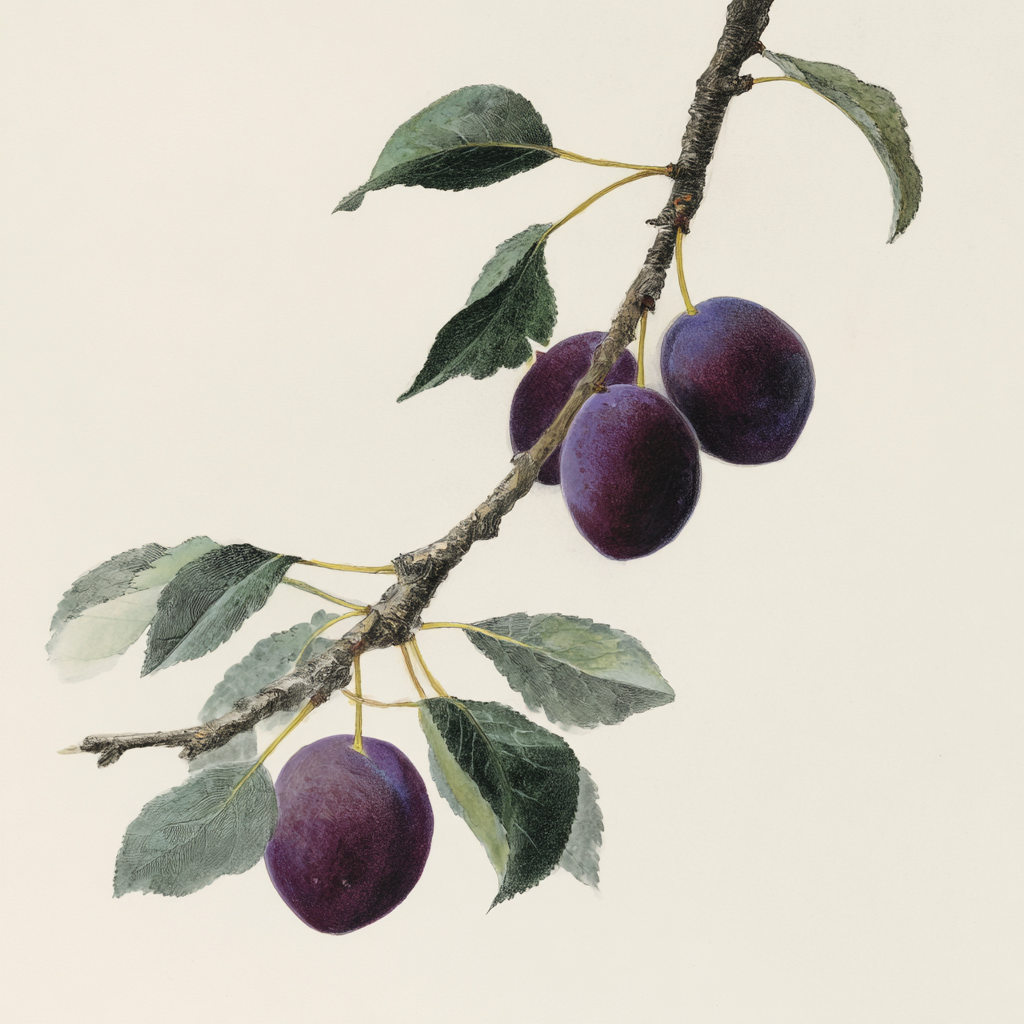
Plums are drupes with a single central stone; skin color at ripeness ranges from near-black and purple to red, yellow, and green depending on variety. Ripe fruit yields to gentle thumb pressure, softens at the tip first, and separates cleanly from the fruiting spur. Fruit left too long on the tree splits in rain or becomes wasp-damaged; harvesting slightly underripe for storage and allowing to finish ripening off the tree is a practical strategy for large harvests.
Natural History
Natural History
Prunus domestica, the European plum, has a complex and still-debated origin story. The prevailing botanical view holds that it arose as a natural or early-cultivated hybrid between the cherry plum (Prunus cerasifera), native to western Asia and the Caucasus, and the blackthorn or sloe (Prunus spinosa), native across Europe. This hybridization event likely occurred in the region spanning the Caucasus into the Caspian lowlands thousands of years ago, and the resulting hexaploid species was distinctive enough to enter cultivation early. Greek and Roman writers documented plums in cultivation - Columella and Pliny the Elder both described multiple named plum varieties grown in Roman orchards, and the Romans are credited with spreading improved cultivars across their empire into France, Britain, and the Rhine valley. By the medieval period, plums were a fixture of monastery gardens and estate orchards across Europe, valued both as fresh fruit and for drying into prunes, which were a critical preserved food source through winter. The word 'plum' traces through Old English 'plume' from Latin 'prunum,' itself borrowed from Greek 'proumnon,' reflecting the ancient circulation of the fruit through Mediterranean trade networks. European colonists carried named plum varieties to North America in the 17th century, where they encountered a continent already rich in native plum species including Prunus americana and Prunus nigra, which Indigenous peoples had long harvested and traded. Breeders later crossed European and Japanese plum species (Prunus salicina, introduced to the West in the 1870s by Luther Burbank) to produce the firm, shipping-hardy plums that dominate commercial production today. For home growers, the most relevant botanical fact is the tree's tendency to form fruiting spurs on two- and three-year-old wood - understanding this rhythm is the foundation of productive pruning and consistent annual harvests.
Traditional Use
Traditional Use
Plums and their dried form, prunes, appear across a wide range of traditional food and folk medicine records in Europe, western Asia, and China, primarily in contexts relating to digestion and as a nourishing or restorative food. The fruit, bark, and leaves of various Prunus species were recorded in herbal texts and folk traditions, though Prunus domestica itself was more consistently documented as a food crop than as a medicinal plant in the formal sense.
Parts Noted Historically
Classical Roman, 1st century CE - fruit
Pliny the Elder in his Naturalis Historia described plums as loosening to the bowels when eaten fresh and noted that Syrian dried plums (prunes) were considered especially valued as a food given to the sick and recovering.
Medieval European herbalism, 12th–15th century - dried fruit, bark
Medieval herbalists including those in the tradition of the Benedictine school at Salerno recorded prunes as a gentle food for the stomach and noted plum bark decoctions in folk contexts, though such uses were far less systematized than those of other Prunus species.
Traditional Chinese medicine, Prunus salicina and related species - fruit, kernel
Chinese medical texts documented li zi (Chinese plum, Prunus salicina) as a food-medicine with records in the Bencao Gangmu (Compendium of Materia Medica, 1596 by Li Shizhen) describing the fruit and kernel in relation to nourishment and various folk applications.
Plum seeds (kernels) contain amygdalin, a cyanogenic glycoside that releases hydrogen cyanide when metabolized; kernels are not safe to eat in quantity. The fruit flesh is safe and widely eaten. Individuals with tree-pollen allergies may experience oral allergy syndrome symptoms with fresh plums.
This information is provided for historical and educational purposes only and is not medical advice. Always consult a qualified healthcare professional before making decisions related to your health.
Related Articles
Related Articles
Grafting Fruit Trees: Techniques, Biology, and Practical Method
Fruit Trees • 16 min read
Fruit Tree Pollination: The Science and How to Plan for Better Yields
Fruit Trees • 17 min read
Pruning Fruit Trees: Techniques, Timing, and the Biology Behind the Cut
Fruit Trees • 18 min read
Fruit Tree Husbandry: A Complete Care Guide
Fruit Trees • 14 min read
Loading photo submission…