Rhubarb
VegetableRheum rhabarbarum
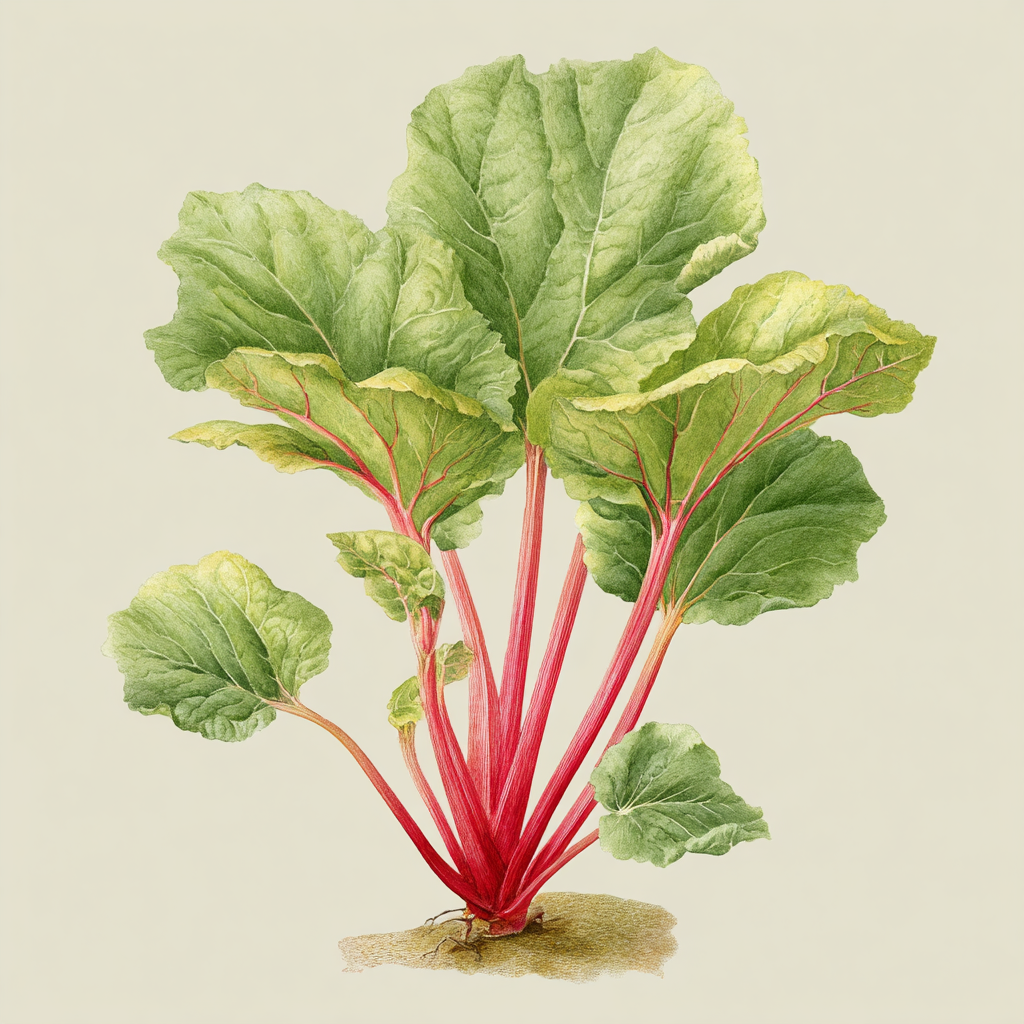
Have seeds for this? Add to inventory →Rhubarb is a hardy perennial grown for its thick, tart stalks, which are among the first harvestable crops of spring. The large, dramatic leaves and bold red or green stems make it an ornamental presence in the kitchen garden, though only the stalks are edible. Established crowns return reliably for decades with minimal inputs, rewarding patient gardeners season after season.
Growing Conditions
Growing Conditions
Sunlight
Full Sun to Partial Shade
Water Needs
Moderate
Soil
Deep, fertile, well-draining loam rich in organic matter with a slightly acidic to neutral pH (6.0–6.8)
Spacing
36 to 48 inches
Days to Maturity
Harvest lightly in year 2; full harvest from year 3 onward
Growing Zones
Growing Zones
Thrives in USDA Zones 3 - 8
When to Plant
When to Plant
Transplant
Plant dormant crowns in early spring as soon as soil can be worked, or in autumn 6 weeks before hard frost
Harvest
Beginning in year 3, harvest stalks from mid-spring through early summer when they reach 10–15 inches; pull and twist stalks at the base rather than cutting; stop harvesting when stalks thin noticeably to allow crown recovery
Phenology (Natural Timing Cues)
Transplant
Plant dormant rhubarb crowns in early spring while the soil is still cool and the crown is not yet breaking dormancy, or in fall before the ground freezes. Spring planting is preferred: the cool, moist conditions let roots establish before summer heat arrives. Planting into warm, dry soil stresses new crowns and stunts first-year growth; fall planting works well in zones 5 and warmer where there is enough time to root in before freeze.
- Forsythia blooming signals soil is workable and cool enough for crown planting
- Dandelions emerging from bare soil indicate frost risk is easing
- Soil drains cleanly and crumbles rather than clumping in the fist
- Nighttime temperatures consistently above 28°F but still reliably below 50°F
Start Dates (Your Location)
Average dates use your saved zone; readiness also checks your forecast when available.
Best Planting Window
Spring window
Early spring
Plant as soon as the soil is workable so roots establish before heat arrives.
Autumn window
Usually skip autumn planting
Use spring unless you have locally grown nursery stock and enough mild weather for roots to establish.
Planting Method
Plant healthy crowns. Seed is possible for some crops, but crowns establish faster and reach useful harvest size sooner.
Critical Timing Note
Plant while dormant and before bud break so roots establish before leaves demand water.
Use the average timing, but check your local forecast before planting.
Typical Harvest Window
April to June
Organic Growing Tips
Organic Growing Tips
Top-dress crowns each spring with 2–3 inches of finished compost or aged manure to feed the deep root system and maintain soil structure
Apply worm castings around the crown perimeter when stalks begin to emerge to give a gentle nitrogen boost without burning
Mulch with straw or wood chips after the ground warms slightly to retain moisture, suppress weeds, and keep roots cool during summer
Brew compost tea from well-finished compost and apply as a soil drench in early spring and again after the harvest season to replenish microbial activity
Remove flower stalks as soon as they appear to redirect the plant's energy back into stalk production and crown building
Avoid planting rhubarb where water pools after rain; raised beds or gently mounded planting sites prevent crown rot, the most common organic-garden failure
Care Guidance
Optional seasonal guidance for what you can do, even when nothing is urgent.
Care Guidance
Watering
If the top 2 inches of soil feel dry, a deep watering at the base may help more than frequent light watering. In healthy soil, rain may cover much of what it needs.
Feeding
If growth is strong, compost-rich soil often carries most of the load. If the plant starts looking pale or stalls, a light compost top-dressing or gentle organic feed may help.
Seasonal care
In late fall, a light cleanup and fresh mulch can help if winter protection is useful in your climate. Leaving a little space around crowns and trunks often helps air move and keeps excess moisture from sitting there.
Harvest timing
Harvests often cluster around April to June. If fruit, leaves, or roots start looking ready, color, size, firmness, and scent usually tell you more than the calendar alone.
Known Varieties
Common cultivars worth knowing
Known Varieties
Victoria
An heirloom variety dating to the 1837 London Horticultural Society exhibitions, producing large, predominantly green stalks with red speckles and excellent tart flavor; reliably productive and widely adapted.
Best for
Cooking, pies, and jam; the most commonly available heirloom crown
Crimson Red
A deeply pigmented cultivar with uniformly red stalks from base to tip, retaining color after cooking; slightly sweeter than green types and very ornamental in the garden.
Best for
Pies, preserves, and fresh use where red color in the finished dish matters
Canada Red
A cold-hardy selection bred for performance in zones 3–4, with sweet, tender red stalks and strong crown vigor after harsh winters.
Best for
Cold-climate gardens in the northern US and Canada
Glaskins Perpetual
A faster-maturing variety that tolerates light harvest in its first year and produces stalks over a longer season than most; less cold-dormancy dependent, making it marginally better for mild-winter regions.
Best for
Growers in zones 7–8 or those wanting an early productive crown
Companion Planting
Companion Planting
Common Pests
Common Pests
All pest management in Garden uses safe, organic, non-toxic methods only. No synthetic pesticides, ever.
Simple Ways to Use
Simple Ways to Use
Start here if you're not sure how to use this crop in the kitchen.
Quick recipes you can make right away
Rhubarb Compote
Slice the stalks into 1-inch pieces, simmer them with a little sugar and a splash of water for 8 to 12 minutes, and stir until the pieces soften and begin to break down. Stop when the mixture turns spoonable but still shows a few soft chunks instead of cooking it into a thin liquid.
Rhubarb Crisp Filling
Cut the stalks into small pieces, toss them with sugar and a little starch, and bake at 375°F until the juices bubble hard at the edges and the stalks are tender when pressed with a spoon, about 30 to 40 minutes. Let the dish rest 10 minutes so the filling thickens before serving.
Small-Batch Rhubarb Sauce
Cook chopped rhubarb with sugar over medium heat for 10 to 15 minutes until the fibers soften and the sauce thickens enough to coat a spoon lightly. Taste near the end and add more sugar only if the sharpness still overwhelms the fruit flavor.
How to Preserve
How to Preserve
Use this section to store or process extra harvest before it spoils.
Practical methods for extra harvest
Freeze chopped rhubarb
Wash the stalks, trim off the leaf ends completely, cut the stalks into pieces, and freeze them on a tray until hard before bagging. Use the frozen pieces straight from the freezer for pie, compote, or sauce, because thawed rhubarb softens quickly.
Freeze cooked sauce
Cook rhubarb into sauce or compote, cool it completely, and freeze it in small containers with a little headspace. Freeze it in recipe-size portions so you can thaw only what you need for yogurt, baking, or dessert topping.
Can rhubarb sauce or jam
Cook the stalks with sugar until fully softened, then pack the hot mixture into jars and process only with a tested rhubarb sauce or jam recipe. Follow the tested recipe exactly for acidity, jar size, and processing time instead of guessing, because safe canning depends on that balance.
New to preserving food?
New to canning? Read the safe canning guide.New to freezing? Read the freezing guide.How to Store
How to Store
Simple storage tips
Remove and discard the leaves right away, because rhubarb leaves are toxic and should not be eaten or stored with the stalks.
Keep the trimmed stalks in the refrigerator and use them within about 1 week while they still feel firm and crisp.
Store the stalks unwashed in a bag or wrapped loosely so they hold moisture without sitting wet.
Use stalks that begin to soften or split first, because older stalks lose their snap quickly once picked.
Do not leave cut rhubarb at room temperature for long, because the stalks wilt and dry out much faster than they do in the refrigerator.
How to Save Seed
How to Save Seed
Step-by-step seed saving
- 1
Rhubarb is usually kept true by dividing crowns, not by saving seed, because seed-grown plants can vary a lot in color, vigor, and eating quality.
- 2
If you want more of the same rhubarb plant, dig and divide a healthy crown while it is dormant instead of saving seed.
- 3
Save seed only for breeding or experimentation, not for keeping a favorite rhubarb strain consistent.
Native Range
Native Range
- Origin
- Native to central Asia and Siberia.
- Native Habitat
- Rocky slopes, mountain meadows, and disturbed ground in central Asia.
- Current Distribution
- Widely cultivated in temperate regions worldwide; naturalized in parts of Europe and North America.
Taxonomy
Taxonomy
- Kingdom
- Plantae
- Family
- Buckwheat family (Polygonaceae)
- Genus
- Rheum
- Species
- Rheum rhabarbarum
Morphology
Morphology
Root System
Rhubarb develops a large, fleshy crown with thick rhizomes and deep, branching roots that store the energy needed to push up stalks each spring; the crown expands outward over years and should be divided when it becomes congested to maintain vigor.
Stem
The edible stalks are thick, succulent petioles - not true stems - ranging from pale green to deep crimson depending on cultivar; stalks that become thin and wiry signal that the crown is stressed, overcrowded, or exhausted from over-harvesting.
Leaves
Leaves are enormous, broadly heart-shaped, and deeply veined, sometimes exceeding two feet across; they are toxic and should be composted or discarded rather than eaten, though they make an effective mulch smothering ground-level weeds when laid around the plant.
Flowers
Rhubarb produces tall, branching flower spikes in late spring or early summer that should be cut out at the base as soon as they appear, since flowering diverts energy from crown and stalk development and significantly reduces harvest yield.
Fruit
After flowering, rhubarb sets small winged seeds on the dried stalk; seed-grown plants are variable in stalk color and vigor compared to crown-divided plants, making seed propagation less useful for home growers seeking consistent quality.
Natural History
Natural History
Rhubarb's cultivated ancestry traces to western China and the adjacent regions of Siberia and Mongolia, where related Rheum species were gathered for their dried roots and traded westward along early caravan routes. The genus name derives from the Latin rhabarbarum, meaning roughly "barbarian root from the Rha River" (the Volga), reflecting the plant's exotic origins to medieval Europeans who knew it mainly as an imported medicine. Garden cultivation of the leafstalk as a food plant developed primarily in Britain during the late 18th century, accelerating when sugar became affordable. Rhubarb's deep, fleshy crown and requirement for cold winter dormancy make it uniquely suited to northern climates where few perennial vegetables thrive.
Traditional Use
Traditional Use
Dried rhubarb root has one of the longest recorded medicinal histories of any plant in the Old World, appearing in Chinese pharmacopoeia texts dating to at least the first century CE and traded to Europe as a costly drug for more than a thousand years. European physicians from the medieval period through the 18th century prized imported Chinese rhubarb root far above the plant's culinary stalks, considering it among the most valuable trade commodities of the apothecary. The edible stalks were a later European culinary development that became widespread only after the plant's medicinal root trade had already established its cultural presence.
Parts Noted Historically
Traditional Chinese Medicine, Shennong Bencao Jing and later pharmacopoeia texts, from at least the 1st century CE onward - dried root and rhizome
Dried Rheum root (da huang) was documented as one of the classical purgative drugs in foundational Chinese materia medica texts, prescribed by physicians for constipation, fevers, and abdominal conditions; it remained a core pharmacopoeia entry through the Qing dynasty
European apothecary trade, 13th–18th century - dried root
Imported Chinese rhubarb root was among the most expensive drugs sold in European apothecary shops; physicians including those trained in Galenic traditions documented its purgative properties, and the root was sometimes weighed against gold in trade records
Rhubarb leaves contain high concentrations of oxalic acid and are toxic if eaten in quantity; only the stalks are safe to eat. The roots contain anthraquinone glycosides and were used historically only in dried, prepared medicinal contexts by trained practitioners.
This information is provided for historical and educational purposes only and is not medical advice. Always consult a qualified healthcare professional before making decisions related to your health.
Loading photo submission…