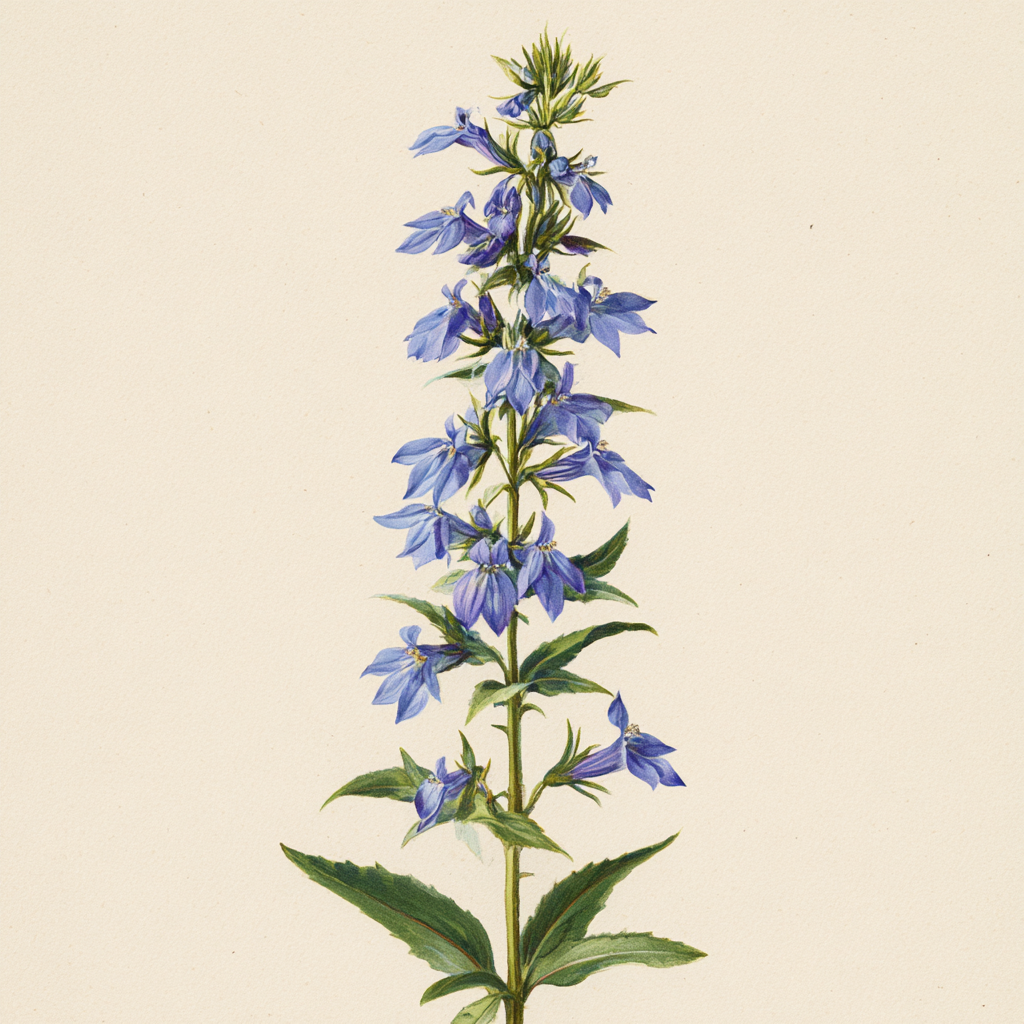
Blue Lobelia
FlowerLobelia siphilitica
Have seeds for this? Add to inventory →Blue Lobelia is a tall native wildflower of moist meadows and streambanks producing vivid royal-blue flower spikes from late summer through autumn. It is one of the most important late-season native bee plants in eastern North America and is especially attractive to bumblebees, which are primary pollinators. It pairs beautifully with Cardinal Flower in rain gardens and streamside plantings.
Growing Conditions
Growing Conditions
Sunlight
Full Sun
Water Needs
Moderate
Soil
Rich, consistently moist to wet soil; pH 5.5 - 7.0; tolerates clay and wet conditions
Spacing
12 - 18 inches
Days to Maturity
Blooms August - October in year two onward; self-sows reliably
Growing Zones
Growing Zones
Thrives in USDA Zones 4 - 9
When to Plant
When to Plant
Direct Sow
Surface sow in autumn for natural stratification, or start indoors 10 weeks before last frost
Harvest
Collect seed capsules as they begin to brown in autumn; seed is very tiny
Phenology (Natural Timing Cues)
Start Indoors
Blue Lobelia is easily started from seed indoors 10 weeks before the last frost date. Surface sow on moist potting mix without covering - seed needs light to germinate. Keep at 65-70°F and germination occurs in 2-3 weeks. Transplant to the garden in moist conditions. It also self-sows reliably once established; a single plant will produce a colony over 3-5 years. The plant typically flowers in its second year from seed.
- Start indoors 10 weeks before the last frost date.
- Surface sow - do not cover seed; light is required.
- Transplant after last frost to consistently moist garden site.
- For autumn sowing outdoors: sow after last hard frost, before ground freezes.
Start Dates (Your Location)
Average dates use your saved zone; readiness also checks your forecast when available.
Average Last Frost
Set your growing zone to see personalized calendar dates.
Use the average timing, but check your local forecast before planting.
Typical Harvest Window
August to October
Organic Growing Tips
Organic Growing Tips
Allow seed heads to mature and disperse naturally; self-seeding maintains the colony.
Mulch around plants to maintain consistent soil moisture - the single most important cultural factor.
In drier gardens, plant in a rain garden, swale, or near a downspout where extra moisture accumulates.
Divide established clumps in spring to propagate; each rosette can be separated and replanted.
Care Guidance
Optional seasonal guidance for what you can do, even when nothing is urgent.
Care Guidance
Watering
If the top 2 inches of soil feel dry, a deep watering at the base may help more than frequent light watering. In healthy soil, rain may cover much of what it needs.
Feeding
Extra feeding is rarely required if soil is healthy. If growth looks pale or slow, a light compost top-dressing is often enough before adding anything stronger.
Seasonal care
In late fall, a light cleanup and fresh mulch can help if winter protection is useful in your climate. Leaving a little space around crowns and trunks often helps air move and keeps excess moisture from sitting there.
Harvest timing
Harvests often cluster around August to October. If fruit, leaves, or roots start looking ready, color, size, firmness, and scent usually tell you more than the calendar alone.
Known Varieties
Common cultivars worth knowing
Known Varieties
Straight Species
Seed-grown Blue Lobelia with the classic royal-blue flower color; some natural variation in flower intensity.
Best for
Rain gardens, streamside plantings, late-season pollinator support
Alba
White-flowered selection; otherwise identical in habit and ecology.
Best for
White gardens, contrast with Cardinal Flower
Companion Planting
Companion Planting
Good companions
- Blue Flag Iris
Support & insectary plants
Nearby plants that attract pollinators, beneficial insects, or improve soil health.
- Cardinal Flower
Attracts pollinators and beneficial insects
- Swamp Milkweed
Attracts pollinators and beneficial insects
- Boneset
Attracts pollinators and beneficial insects
- Joe-Pye Weed
Attracts pollinators and beneficial insects
Avoid planting near
No known conflicts
Common Pests
Common Pests
All pest management in Garden uses safe, organic, non-toxic methods only. No synthetic pesticides, ever.
Native Range
Native Range
- Origin
- Native to eastern and central North America.
- Native Habitat
- Moist meadows, streambanks, wet woods, floodplain edges, and seeps.
- Current Distribution
- Widespread across eastern North America within native range; cultivated in wet and rain gardens across temperate regions.
Taxonomy
Taxonomy
- Kingdom
- Plantae
- Family
- Bellflower family (Campanulaceae)
- Genus
- Lobelia
- Species
- siphilitica
Morphology
Morphology
Root System
Fibrous, shallow roots with a basal rosette that persists through winter; plants spread slowly by offsets.
Stem
Single upright stem 2 - 4 feet tall; hairy; leafy throughout; bearing a long terminal flower spike.
Leaves
Alternate, lance-shaped to oblong; slightly toothed; pale green; progressively smaller up the stem.
Flowers
Irregular, two-lipped blue to blue-violet flowers 1 inch long crowded into a long terminal spike; bloom August through October; deeply attractive to long-tongued bumblebees.
Fruit
Small round capsules containing many tiny seeds; capsules split to release seed when mature in autumn.
Natural History
Natural History
Lobelia siphilitica is native to moist meadows, streambanks, wet woods, and floodplain edges across eastern and central North America from New England west to Nebraska and south to Alabama. The species epithet siphilitica reflects a 17th-century account - reported by the explorer Sir William Johnson, who received the information from Iroquois peoples - that the root was used to treat syphilis. This claim attracted considerable European medical interest, and specimens were sent to European herbalists and physicians who investigated but could not confirm the claimed properties. Despite the misleading epithet, the plant has an extensive and genuine documentation of use for other conditions in Indigenous traditions. Blue Lobelia is ecologically paired with Cardinal Flower (Lobelia cardinalis) - their flowering times, habitats, and pollinators overlap but differ: Blue Lobelia serves bumblebees (with tongues long enough to access the deep blue flowers) while Cardinal Flower serves hummingbirds. Together they represent an elegant partitioning of pollinator resources in late-summer wet habitats.
Loading photo submission…