
Buckwheat
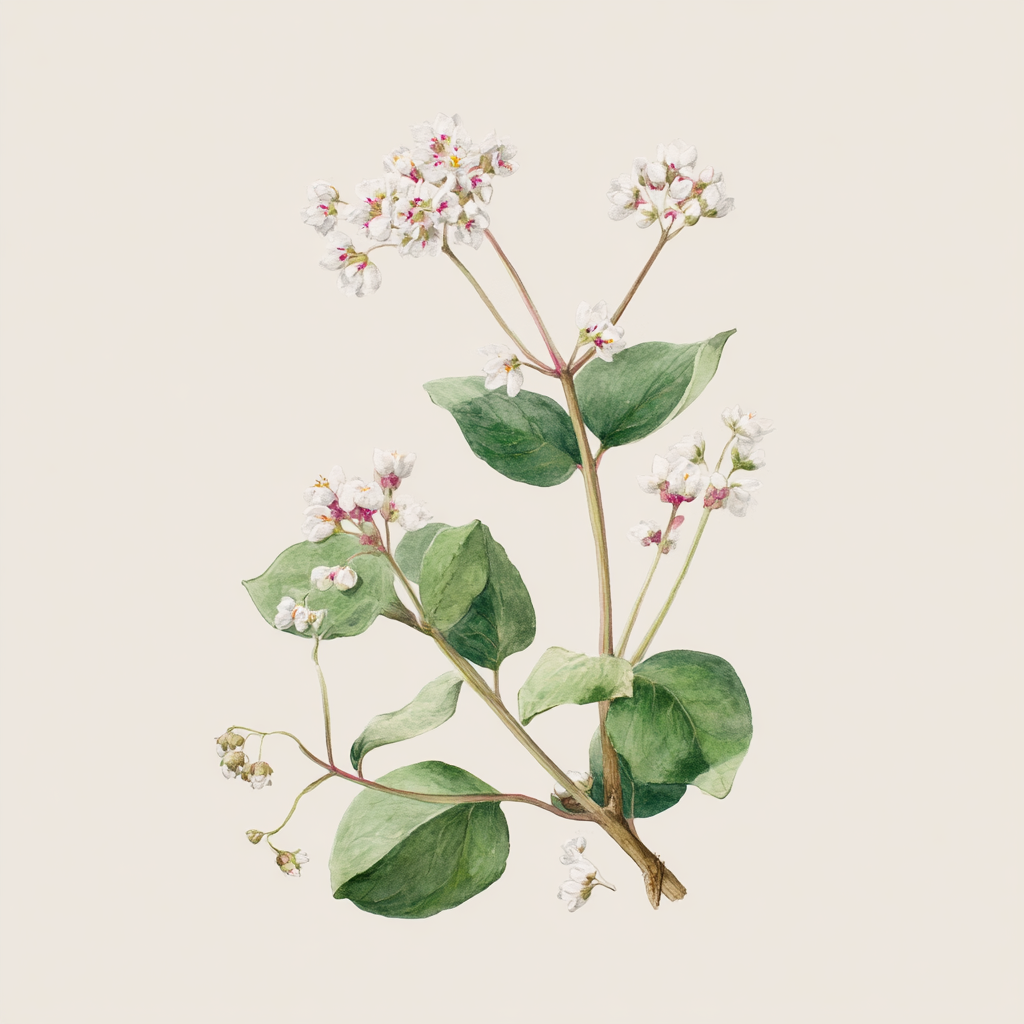
FlowerFagopyrum esculentum
Have seeds for this? Add to inventory →Buckwheat is the premier warm-season cover crop for summer bed gaps, capable of germinating and covering bare ground in as little as 5 days and producing a weed-smothering canopy within 3-4 weeks. Despite its name it is not a grass but a broadleaf plant in the dock family; its seeds produce the flour used in buckwheat pancakes, soba noodles, and kasha. The tiny white flowers are extraordinary pollinator resources, drawing honey bees, native bees, hoverflies, and parasitic wasps in remarkable density - buckwheat is a favourite of organic farmers specifically for building beneficial insect populations between cash crops. Terminate before seed set to prevent unwanted reseeding.
Growing Conditions
Growing Conditions
Sunlight
Full Sun
Water Needs
Low to Moderate
Soil
Tolerates poor, heavy, or acidic soils; mobilises phosphorus from forms unavailable to most crops. pH 5.0 - 7.0
Spacing
Broadcast at 2-3 oz per 100 sq ft; no thinning required
Days to Maturity
35-45 days to flowering; terminate at 10-30% bloom for best pollinator benefit and before seed hardening
Growing Zones
Growing Zones
Thrives in USDA Zones 3 - 10
When to Plant
When to Plant
Direct Sow
Broadcast on cleared beds and rake in; sow any time after last frost through midsummer (not an autumn cover crop - buckwheat is frost-sensitive and used only in the warm season). Ideal to fill the gap between spring crops coming out and autumn crops going in. Germinates in 3-5 days in warm soil.
Harvest
Grain harvest is possible by cutting stalks when 75% of seeds have turned brown, then drying and threshing. For cover crop use only, mow and incorporate 2-4 weeks before next planting, before seeds harden and drop.
Phenology (Natural Timing Cues)
Direct Sow
Buckwheat is a warm-season cover crop that fills the midsummer gap between spring and autumn plantings. It grows extraordinarily fast - covering bare soil in 2-3 weeks and flowering in 35-45 days. The key management decision is when to terminate: mow at 10-30% bloom for the best balance of pollinator benefit and weed prevention. Buckwheat that sets and drops seed will germinate heavily the following year.
- Spring crops (peas, lettuce, spinach) have been harvested and the bed is empty.
- Soil temperature is consistently above 55°F.
- At least 6 weeks remain before autumn crops need to go in.
Start Dates (Your Location)
Average dates use your saved zone; readiness also checks your forecast when available.
Average Last Frost
Set your growing zone to see personalized calendar dates.
Use the average timing, but check your local forecast before planting.
Organic Growing Tips
Organic Growing Tips
Leave 10-20% of the stand to flower fully before mowing to maximise the beneficial insect bloom; the hoverflies and parasitic wasps attracted will establish populations that persist into your vegetable crops.
Buckwheat makes phosphorus more available in the soil; tests often show improved phosphorus levels after a buckwheat rotation.
In hot climates, sow later in the day so seeds are not sitting in peak afternoon heat during their critical first germination hours.
Care Guidance
Optional seasonal guidance for what you can do, even when nothing is urgent.
Care Guidance
Watering
If dry weather lingers, let the top 2 inches start to dry before watering again. This plant often responds better to an occasional deep soak than to frequent light watering.
Feeding
Extra feeding is rarely required if soil is healthy. If growth looks pale or slow, a light compost top-dressing is often enough before adding anything stronger.
Seasonal care
During the main season, harvesting when the crop is ready and removing damaged growth can help keep the planting productive if it starts to look crowded or tired.
Known Varieties
Common cultivars worth knowing
Known Varieties
Common Buckwheat
The standard agricultural type used for cover cropping and grain; widely available in bulk from seed suppliers.
Best for
General cover crop use; most available and reliable
Mancan
Canadian variety with high yield potential and large seeds; popular for grain production as well as cover cropping.
Best for
Dual-purpose: cover crop and grain harvest
Tokyo
Japanese variety grown for soba noodle flour production; smaller-seeded with finer milling characteristics than standard types.
Best for
Home grain production; soba flour
Companion Planting
Companion Planting
Good companions
- phacelia
Support & insectary plants
Nearby plants that attract pollinators, beneficial insects, or improve soil health.
- crimson-clover
Nitrogen-fixing; attracts pollinators
Avoid planting near
No known conflicts
Common Pests
Common Pests
All pest management in Garden uses safe, organic, non-toxic methods only. No synthetic pesticides, ever.
Native Range
Native Range
- Origin
- Domesticated in China or Central Asia; wild progenitors native to mountainous regions of southwestern China, Tibet, and adjacent areas.
- Native Habitat
- No truly wild populations of the cultivated form exist; cultivated in disturbed, open agricultural land across temperate and subtropical regions.
- Current Distribution
- Cultivated worldwide across temperate regions; major grain crop in Russia, Ukraine, China, Japan, Poland, and France; grown as a cover crop throughout North America and Europe.
Taxonomy
Taxonomy
- Kingdom
- Plantae
- Family
- Buckwheat family (Polygonaceae)
- Genus
- Fagopyrum
- Species
- Fagopyrum esculentum
Morphology
Morphology
Root System
Shallow, fibrous root system; roots release organic acids that solubilise bound phosphorus in the soil - one of the most significant agronomic traits of the species.
Stem
Erect, hollow, reddish-green stems 2-4 feet tall; branching from the base in open-grown plants.
Leaves
Heart- to arrowhead-shaped, alternate, smooth, bright green; ochrea (sheath) at each node typical of the Polygonaceae family.
Flowers
Tiny, 5-petalled white or pale pink flowers in dense clusters; intensely attractive to pollinators due to accessible, exposed nectaries.
Fruit
Triangular, three-angled achene (grain) 4-6mm long; brown-grey to dark brown at maturity; the edible grain ground into buckwheat flour.
Natural History
Natural History
Fagopyrum esculentum was domesticated in China or possibly Central Asia, with archaeological evidence of cultivation in China and Korea dating to at least 6000 BCE. It spread westward along trade routes into Central Asia and reached Europe by the 14th century, where it became an important crop in Russia, Ukraine, Poland, and Brittany - regions with short growing seasons and poor soils that limited wheat and rye production. The English name "buckwheat" derives from the Dutch "boekweit" (book wheat), referring to the resemblance of the triangular seeds to beech nuts. Despite the name, buckwheat is botanically unrelated to wheat and is naturally gluten-free, which has driven renewed interest as a specialty food ingredient. Its rapid growth, self-seeding tendency, and tolerance of poor soils led to its use as a summer cover crop and green manure in early American agriculture, a practice documented in agricultural literature from the 18th century onward. Organic farming research from the 1980s onward rediscovered and quantified its value as a beneficial insect habitat and phosphorus-cycling cover crop, cementing its place as the standard summer cover crop recommendation.
Loading photo submission…